- R1D2 radar sensor for mobile applications
- Technology
R1D narrow beam distance sensor: Technology
Radar sensors are known for their robustness, precision, and flexibility, making them reliable for performance in harsh environments. ifm offers 60 GHz and 77 GHz radar technologies to meet the demanding needs of industrial and vehicular operations in the US. These non-contact sensors provide cost-effective solutions for distance measurement, motion and object detection, and driver assistance, even in challenging conditions like rain, snow, smoke, dust, and darkness.
ifm’s radar ground speed sensors use FMCW (Frequency Modulated Continuous Wave) technology to measure distance and velocity with high accuracy. The Doppler effect helps determine the velocity of moving targets by analyzing the frequency shift of the reflected waves. The R1D radar sensors also offer excellent distance resolution, enabling them to distinguish between closely spaced objects. Their ability to operate in all weather conditions and their robustness against environmental factors make them ideal for various applications.
Radio waves detect, locate, and track objects
Radar, which stands for Radio Detection and Ranging, is a technology using radio waves to detect, locate, and track objects. It has a wide range of applications, including aviation, meteorology, maritime navigation, traffic control and object detection in the industrial world. The basic principle behind radar involves the transmission of radio frequency (RF) signals and the reception of their reflections from objects in the environment.
A radar sensor consists of a transmitter that emits electromagnetic waves in the microwave frequency range. The emitted radio waves travel through the air at the speed of light. When the waves come across an object in their path, some of the energy is reflected back to the receiver of the sensor and processed by the microprocessor and distance is calculated.

ifm radar sensors transmit RF waves in the microwave frequency range

Distance is proportional to the frequency change between transmitted and received signals
FMCW technology measures distance and velocity
ifm’s radar position sensor utilizes FMCW (Frequency Modulated Continuous Wave) technology to measure distance and velocity of one or multiple objects. The sensor continuously transmits a signal with a frequency that varies linearly over time. The modulation allows the radar sensor to achieve better range resolution, accuracy and sensitivity compared to other technologies.
The range to the target is determined by analyzing the frequency difference between the transmitted and received signals. This frequency difference is related to the round-trip time of the signal and can be used to calculate the distance to the target(s).
Doppler effect allows radar to determine velocity
Radar can also make use of the Doppler effect to determine the velocity of the target. RF signals are transmitted by the sensor and are reflected back to the sensor after hitting a target. If the target is moving toward or away from the sensor, the frequency of the reflected waves change, increasing if the target is moving toward the sensor and decreasing if the target is moving away from the sensor.
This shift in frequency is detected and measured by the sensor and it is directly proportional to the speed of the target. The greater the shift, the faster the target is moving.
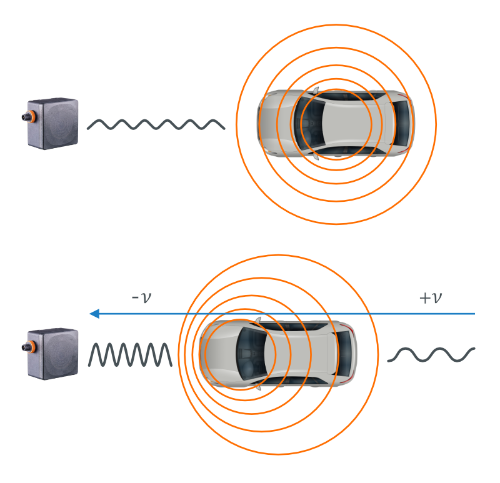
Reflected frequency changes as an object is moving toward or away from the sensor

RCS as a function of distance and target
Radar cross-section (RCS)
The radar cross-section (RCS), also known as radar signature, is a measure of how well an object is detectable by radar. RCS is a measure of reflective characteristics of an object when irradiated by radar waves.
- Effective area that a target reflects signals back to the sensor
- Often expressed in m2
- Highly dependant on frequency of the radar waves
- Object shape and geometry have an influence. Flat and angled surfaces tend to have larger RCS than round surfaces
- Object material and coating have an influence
As a general rule of thumb, the higher the dielectric constant and the larger the object size, the higher the RCS and, therefore, the better the visibility to a radar sensor.
Ground speed measurement
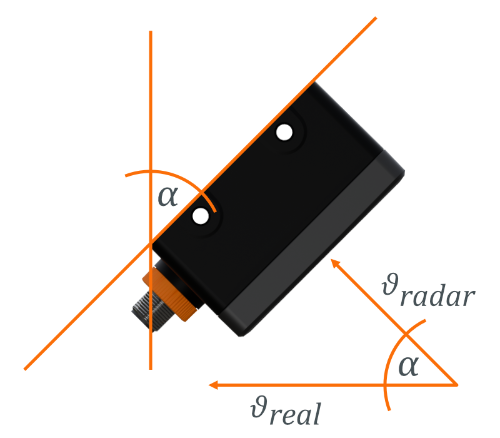
To measure the relative speed between the sensor and the ground, the sensor must be mounted at an optimized angle. The radar sensor measures the frequency shift of the radar waves as they reflect off the ground. If the sensor is pointed directly down at the ground, the Doppler shift might be too small to be detected. The angle ensures that the radar waves are more effectively interacting with the moving surface, resulting in a measurable Doppler shift.

Non-contact detection
Non-contact sensing technology allowing it to detect and track objects without physical contact.

Reliable detection of speed and direction
The R1D sensor analyzes the frequency change over multiple modulation cycles to reliably calculate speed and direction, making it a versatile solution for many applications.

All-weather operation
Radio frequency waves penetrate through rain, dust, fog, and snow, unlike optical sensors that can be obstructed by these conditions. Changes in ambient light also do not affect this technolgoy.

Unparalled range
Radar technology provides long-range detection, allowing for the monitoring and tracking objects at considerable distances. ifm’s radar sensor can reach up to 50m in range.

Easy installation
The electromagnetic waves emitted by a radar sensor can penetrate a wide variety of materials. This allows the sensor to detect objects behind obstacles or within structures, making it useful to detect level through a plastic tank wall.

Accurate distance measurement
Advanced frequency modulated continuous wave radar sensor technology allows for more precise distance measurement than other radar technologies. It is based on calculating the frequency difference between the transmitted and received signals, which is directly proportional to the object distance.

Robustness
Radar technology is known for its reliability and robustness. It is less effected by environmental conditions, electromagnetic interference, and other external factors that may impact the performance of other sensor technologies.

Very fast response time
Since the R1D continuously transmits and receives signals from a detected object, there is little delay in processing, making it Ideal for high speed conveying applications