Standard photoelectric sensors: Reliable object detection
|
Model |
Background suppression range | Retro-reflective range | Through-beam range | Accuracy | IP Rating | Interface | Learn more |
|---|---|---|---|---|---|---|---|
 |
300 mm | 5 m | 25 m | 25 mm | IP65, IP67, IP68, IP69K | Potentiometer, Pushbuttons, Fixed range |  |
 |
200 mm | 4 m | 20 m | 7 mm | IP65, IP67, IP68, IP69K | Pushbuttons, Fixed range | |
 |
80 mm | 1.8 m | 3 m | 4 mm | IP65, IP67 | Fixed range | |
 |
200 mm | 5 m | 10 m | 4 mm | IP65, IP67, IP68, IP69K | Potentiometer | |
 |
1.8 m | 10 m | 25 m | 200 mm | IP65, IP67 | Pushbuttons | |
Technology overview
Through beam technology
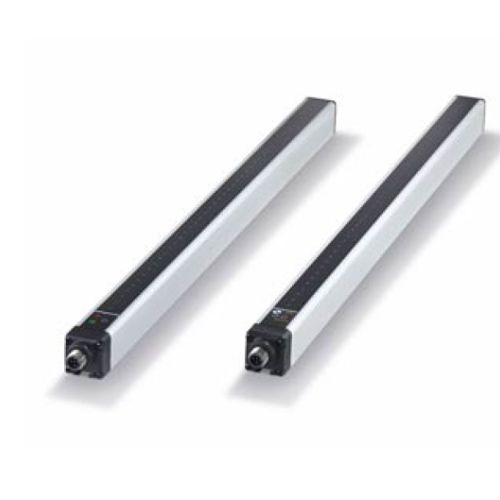
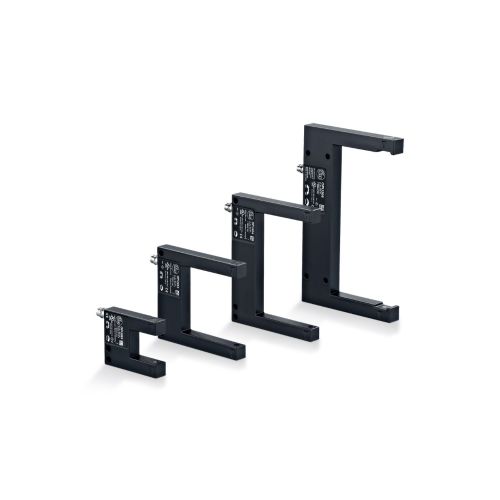
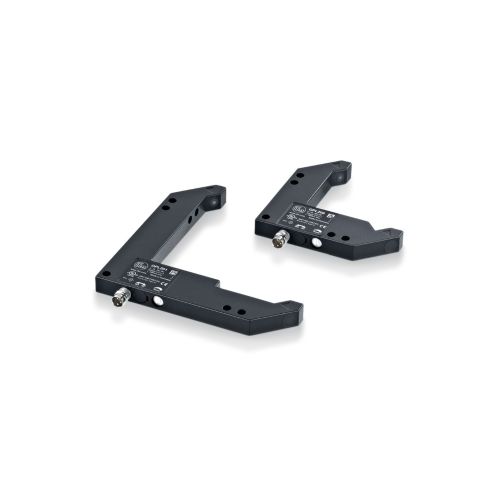
Also known as through beam / thru-beam pairs. The transmitter and receiver are packaged in separate housings and are mounted opposite each other. Light is sent from the transmitter lens and is picked up by the receiver lens

The output changes state when a target interrupts the beam and starves the receiver of light. As long as the target is large and solid enough to break the effective beam, the color, shape, angle, reflectivity and surface finish will not affect the application. This makes them more reliable than diffuse sensors, which depend on light reflecting off the target.

The effective beam is uniform in diameter and is approximately equal to the diameter of the transmitter and receiver lenses. So long as the target is at least as big as the effective beam, the output will switch when the target breaks the beam.
Installation considerations:
Retroreflective technology with polarizing filter
The transmitter and receiver are packaged in the same housing and mounted opposite a reflector. Light is sent from the transmitter lens, bounces off the reflector and returns to the receiver lens.

As with thru-beam sensors, the output changes state when a target interrupts the beam and starves the receiver of light. As long as the target is large and solid enough to break the effective beam, the color, shape, angle, reflectivity and surface finish will not affect the application. This makes them more reliable than diffuse sensors, which depend on light reflecting off the target.

The effective beam of polarized retroreflective sensors is cone-shaped. Near the sensor, the beam is approximately the size of the transmitter lens. Near the reflector, it is the size of the reflector. This means that smaller objects can be detected when close to the sensor, but not necessarily when close to the reflector.

Prismatic reflectors are required for polarized retroreflective sensors. By their design, these reflectors rotate the incoming light beam by 90 degrees. The sensors are equipped with polarizing filters over the lens so light waves are oriented in one direction only. The reflector rotates the light waves to match the orientation of the filter on the receiver.
Shiny targets may return high intensity light to the sensor, but since the light is not properly oriented, the shiny targets will not cause a false signal.
Diffuse technology
The transmitter and receiver in a diffuse sensor is located in the same housing. The transmitted light reflects back to the sensor from the target and the receiver evaluates it. It is important to carefully consider the characteristics of the target and the background behind the target when selecting the correct solution for an application. Diffuse sensors have much less excess gain than thru-beam pairs, but typically more than polarized retroreflective types.

The sensitivity of diffuse sensors is very high. Only 2% of the transmitted light energy reflected off the target will cause the output to switch.
Target influences:
Background interference
A diffuse sensor detects all light reflected into the receiver, regardless of its source. Light reflecting off the background appears the same as light from the target and is especially troubling when the background is more reflective than the target and when the target and background are very close together.
Diffuse technology with background suppression
These sensors are specially designed diffuse sensors that eliminate false tripping on the background behind the target. Several technologies suppress backgrounds including:

Fixed range
The position of the transmitter and receiver lenses are angled to create a detection zone. Objects in the detection zone reflect light into the receiving lens and are sensed. Objects outside the detection zone (either too close or too far) do not have the correct geometry to return light to receiver. This method is normally used for short range and is not adjustable.

Triangulation principle
This technology uses two receiving elements to obtain background suppression. Using a potentiometer for adjustment, a mirror is mechanically positioned to determine the point where one receiver detects the target and the other detects the background. The sensor is then adjusted halfway between these two points. The sensor evaluates the angle of the received light to determine if the light comes from the target or the background.

Diode array
This method is similar to the triangulation principle, except the receivers are a 63-diode array. The additional receivers allow for precise background suppression (i.e., the target and background can be very close). Diode array sensors are equipped with a microprocessor and programmed electronically via pushbuttons.