P|Prox displacement sensor: Extreme precision measurement for all metals
The IxP precision proximity sensor (P|Prox) family performs the work of a traditional displacement sensor at a fraction of the price in industries such as automotive, factory automation, food & beverage, machine tools, and metalworking.
The state-of-the-art technology enables reliable operation even when exposed to high magnetic fields. The P|Prox proximity sensor, with excellent repeatability, ensures process stability and improves product quality by measuring absolute distance values between the active sensing face and a metallic target directly in pure digital form.
The inductance change is measured and converted into an absolute distance value in the microcontroller without A/D conversion losses. This allows the sensor to provide sub-micron resolution. Accuracy and repeatability remain constant regardless of the target metals.
 |
 |
 |
||
| Improve process stability and product quality | Reduce total cost of ownership | Simplify complexity | ||
|---|---|---|---|---|
|
|
|
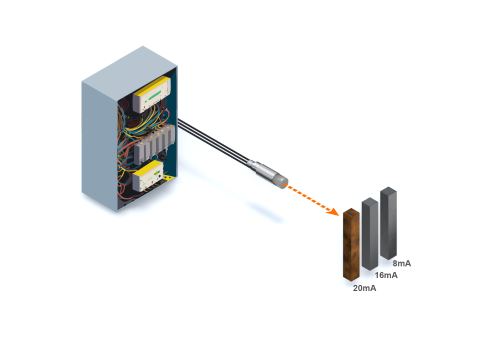
Traditional analog sensor
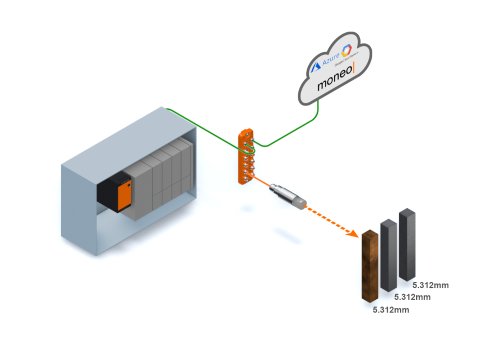
P|Prox displacement sensor with IO-Link

Accuracy and repeatability vary
- Factors such as thermal noise, signal attenuation, temperature, and other influences affect negatively affect analog signals.
- Degradation of analog signals lead to toss of information and reduced measurement accuracy.
State-of-the-art technology provides sub-micron accuracy and repeatability
- P|Prox measures the distance to the target and directly converts this measurement into a digital distance value within its microchip.
- Minute changes in distance can be measured and signaled. No internal conversion losses provide consistent accuracy and repeatability.
- Low temperature drift.

Time-consuming adjustments, calibraion, and manual scaling
- Applications requiing high resolution measurements often require time-consuming on-site calibration.
- Mechanical fine adjustments using spacers is usually performed after the sensor is installed.
- Analog signal is proportional to the measured distance and manual scaling is generally required.
Plug-and-Work solution
- Since the output is absolute distance in mm, no manual scaling is required.
- Default calibration is done with aluminum.
- Standard performance, acceptible most applications, is achieved with other metals such as steel, and stainless steel
- For specialty applications such as detection of small objects, calibration can be done in seconds.

One sensor for one type of metal
- Traditionally, to achieve high accuracy, the application is target-dependent and the sensor is calibrated for one type of metal.
- For other metals, a new sensor custom calibration is required.
One sensor for ALL metals
- No reduction in range, and accuracy and resolution of distance measurement are constant with all metals.
- Simplifies the integration and reduces inventory complexity.

No additional diagnostics
- Traditional inductive sensors only output discrete or analog signals that are susceptible to noise interferences.
- Connection requires long home run cables or direct connections, often with hundreds of wire terminations.
- Information on sensor health and application strength is not available.
Unlock the power of IO-Link
- Information such as real-time alerts and reactions, device temperature, and other device diagnostics are available.
- P|Prox connects to an IO-Link master via an industry standard M12 A-coded cordset.