
- Mobile market segments
- Transportation equipment
Transportation and logistics equipment
In the transportation of products and materials via road, maritime, rail, and air, vehicles encounter extreme operating conditions and potential electromagnetic interference. ifm offers solutions for various transportation equipment.
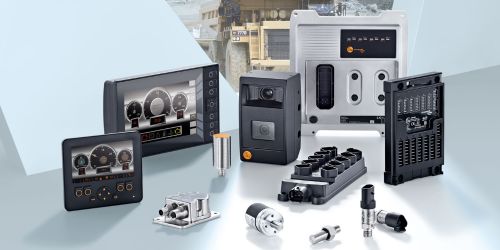
Our sensors and control systems incorporate complex electronics that protect against electromagnetic interference. Within the ecomatmobile portfolio, ifm offers robust controllers, HMIs, I/O modules, and sensors designed specifically for these applications. The systems effectively filter out conducted interference, preventing any impact on the controllers. This ensures the reliable functionality of data exchange through CAN interfaces, even in challenging conditions, such as outdoor applications in transport and logistics.

Benefits of automated material handling

Shorten delivery times:
Automating equipment and advancing technology lead to real-time route optimization, accelerated processes such as loading and unloading cargo using equipment capable of handling heavier loads for extended periods, and enhanced interconnection for the seamless transfer of goods between two modes of transportation.

Maximized storage space:
Automation helps with space optimization by allowing materials to be stored at greater heights and stacked atop one another. Also, stored items become more accessible, leading to floor space savings in the warehouse.

Increased safety:
Manual tasks performed by human workers, such as heavy and repetitive lifting, pose a risk of injuries. Vehicles equipped with sensing and control technology help workers perform potentially hazardous tasks in a smooth, controlled manner, reducing the likelihood of human-operated vehicles injuring other employees.

Real-time data:
Real-time data offers visibility into the operations, empowering you to make informed business decisions based on trends and historical insights. Having valuable data at your fingertips gives you the power to automate the decision-making process and predict maintenance needs before failures occur.

Overcome high transportation costs:
Reducing transportation costs involves minimizing fuel, labor, and maintenance expenses. Real-time GPS monitoring enables performance tracking by jobsite, lowering fuel consumption. Fuel-efficient or electric vehicles with advanced safety features decrease accident risks, aiding in cost reduction. Autonomous vehicles cut labor costs, and real-time maintenance predicts and schedules equipment maintenance, minimizing downtime.

Improve customer experience:
With many customers in remote locations around the world, modern solutions such as virtual and augmented reality prove invaluable for self-repair support. Valuable data can be collected remotely and used for product development. When customers need support, OEMs can monitor equipment status and proactively offer maintenance.

Airport GSE (ground support equipment)
Aircraft tractor: Frequently employed to tow aircrafts away from gates, the nose wheel must align accurately with the aircraft tractor. Proximity sensors precisely detect positions within the locator, and the signals are evaluated by a decentralized ecomatController. Simultaneously, it controls and monitors proportional valves for hydraulic functions. This ensures the hydraulic system applies force with the utmost precision, adapted to the preselected aircraft type via the ecomatDisplay, preventing damage to the nose wheels.

Automated Guided Vehicle (AGV)
An AGV navigates along invisible paths in the terminal area, precisely transporting containers to designated storage or loading positions. The system's high loading and unloading speed demands reliable technology. Vehicles can be customized with various engines, chassis, hydraulics, and electronics based on customer preferences.
The components of the ecomatmobile product range control the traction drive and assess numerous sensors for mobile applications. A robust ecomatDisplay HMI provides service information and, if needed, displays fault and error messages.
Autonomous shuttles are a type of AGV used to move people and goods. Encoders ensure precision in odometry, displays enable passengers to pick destinations and view route data, and controllers manage electric motor control and battery management interfaces.

Reach stacker / collision avoidance
In container ports globally, reach stackers, weighing dozens of tons and often posing challenges, are utilized for stacking and handling containers. To prevent collisions during tight and rapid maneuvers, ifm provides automatic collision avoidance: A rear-mounted 3D camera monitors the rear area, detects objects in the travel path, and alerts the driver to potential collisions.

Hi-Rail vehicle (maintenance of way equipment)
Reliability and safety are not accidental; they stem from proven technology. This is guaranteed by relevant approvals, such as the e1 type approval from the German Federal Motor Transport Authority (Kraftfahrt-Bundesamt) or certification for use in rail vehicles. The menu-guided operation ensures swift and secure shunting. The control components allow the driver to seamlessly transition from rail to road.
Sensing
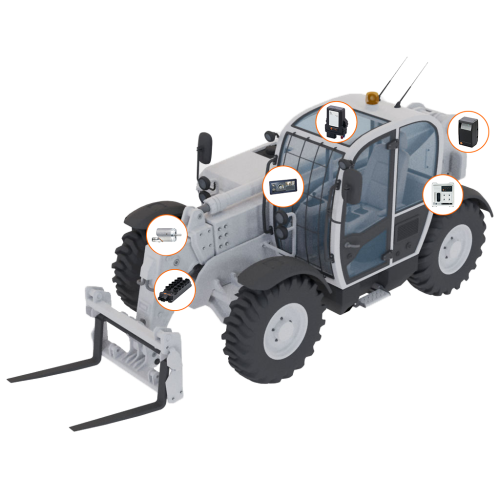
- Cameras: Mobile cameras are used for area protection and can react to an obstacle before the driver sees it, automatically halting the vehicle to avoid collision.
- Position: Inductive sensors, designed to ensure highest shock and vibration resistance, reduce failures from mechanical damage with extended sensing range.
- Encoders: Encoders for mobile use ensure precise positioning of the boom and transmit its position to the PLC.
Control
- Hardened PLCs: Automate functions with scalable I/O configuration. Two independent processors allows your machine to be SIL 2 certified.
- HMI controllers: HMI controllers have an integrated PLC for data visualization, data acquisition and communication via a connected modem.
- ioControl: A centralized I/O module connected to the controller via CAN.
- Cellular modem: Over-the-air (OTA) updates or online diagnostics of the machine software in close coordination between the machine operator and the manufacturer
- CODESYS software: Programming via CODESYS is clear and simple for the user. Function libraries are available for special hardware functions.
Challenges
- Labor shortages: Difficulties in hiring have led to a labor shortage of truck drivers and warehouse employees, directly impacting the transportation and logistics industry. The three most critical consequences include supply chain delays, higher costs, and capacity issues.
- Remote services and data analytics: Consumers are demanding faster and more reliable deliveries at lower prices. Meeting this demand necessitates the adoption of new technologies to enhance the traceability and predictability of distribution networks. Logistics companies are exploring real-time big data analytics to optimize their supply chains.
- Autonomous vehicles: Autonomous cars will only have milliseconds to react to events such as a pedestrian stepping out into the road. Sending data back to the data center to be analyzed is no longer an option.
- Compliance and sustainability: Stricter environmental regulations are mandating fuel efficiency and lower emissions. Sustainable products that are environmentally-friendly, energy-efficient, and have smaller carbon footprints are also becoming more important to customers.
Solutions
- Autonomous vehicles and automation hardware and software are used for tasks that were once performed by humans. Machines that pick and pack items are part of the solution to meet the challenges of labor shortages in warehouses. And autonomous vehicles can help with a decline in truck drivers.
- Machine learning software can also fill the void in labor, as it can scan vast amounts of data in seconds to formulate solutions for system problems. Edge-powered devices integrated with machine learning software can process data instantly, automating the decision making process freeing up customers' time for more skilled tasks.
- Cameras and sensors integrated with controllers and edge-processing devices allow for quick decision making for collision avoidance.
- Eco-friendly solutions are becoming important to governments and consumers. Penalties on polluters will force manufacturers to embrace green solutions.


