- Mobile market segments
- Construction equipment
Automation in construction equipment
Automation offers clear advantages, including increased productivity and efficiency. Additionally, it often translates into environmental and sustainable benefits. Whether automating manual tasks on-site or monitoring vehicle performance and fuel consumption, this technological integration allows for reliable and optimized operation across a range of construction vehicles, from excavators to bulldozers.
When operating heavy mobile machines, operators must comply with all current safety regulations to ensure safe operation. As safety regulations change on a regular basis, it is particularly important that the safety systems are flexible so that they can be adapted to the requirements at any time. All components in the systems, e.g. sensors, controls or user interface displays, must be suitable for the difficult environmental conditions in which mobile machines are used.
Benefits of automated construction

Enhanced safety:
The use of camera technologies and collision avoidance systems assist workers operating heavy machinery by detecting people or objects and providing an alert or stopping movement. Automation can eliminate risks of human error with autonomous vehicles. Or heavy machinery can be operated with remote control systems eliminating the possible harm of accidents on construction sites.

Improved operational efficiency:
With automated equipment, construction projects can be completed quicker because machinery does not need breaks like humans and continuously operate at the same speed.
Automation of repetitive tasks increases precision, accuracy, and consistency in tasks such as digging, grading, and concrete mixing.

Better resource management:
Real-time data on fuel consumption, inventory levels, and equipment utilization minimizes waste and maximizes output. Data can be analyzed and resources can be adapted to improve sustainability.

Reduced downtime:
Predictive maintenance with root cause analysis detects components that need replacement or maintenance before causing a failure resulting in downtime. Utilization of machine learning algorithms optimize heavy machinery performance.

Reduce costs:
Savings are made in various categories such as labor costs, reducing material waste, predictive maintenance and minimizing project delays.

Scalability:
When construction projects can standardize on components, necessary elements can be manufactured quickly at various scales because of automation.

Wheeled excavator
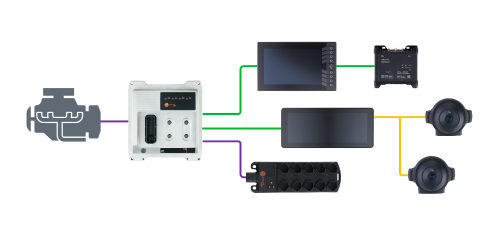
Lifting, rotating, turning and driving - the ecomatController reliably performs all these tasks in a wheeled excavator. Hydraulic valves can be controlled sensitively thanks to the flexible output functions. Communication with the diesel engine via the CAN bus enables power control, e.g. by increasing the speed during work tasks. To ensure smooth operation of the machine, a direct dialogue between machine and operator is required. This is where the ecomatDisplay comes in. It can be used to display system error messages and view and adjust all important operating parameters.

Bridge inspection platform
ifm offers the powerful ecomatController for safety-related applications in mobile machines. The unit excels in complex and demanding control functions, e.g. in a bridge inspection platform. The ecomatContoller has been developed to current safety standards. Hardware and software have been certified by the German TÜV association.
The ecomatContoller supports the operator as a safety controller, ensuring reliable operational processes on the platform in line with the high demands.

Drilling rig
Vibrations and extreme shaking in a drilling rig are no problem for ifm’s ecomatmobile components. The high protection rating and the advanced mechanical design guarantee permanently reliable operation.
The powerful mobile controllers were developed on the basis of the current standards and long-term experience to carry out the complex functions in mobile machines. The controllers are equipped with 4 CAN interfaces. They support all important bus protocols, different baud rates and also the transparent and preprocessed data exchange. Programming with CODESYS to IEC 61131-3 ensures that all control functions can be easily integrated in the application program.

Stone crusher
Vibrations and extreme shaking in a stone crusher are no problem for ecomatmobile. The high protection rating and the advanced mechanical concept guarantee permanently reliable operation. This does not only apply for the controllers, but also for the I/O modules with DEUTSCH or M12 connection technology and the powerful and robust displays. The latter are used both for operation and to display system messages.

Soil stabilizer
Operating under extreme operating conditions: decentralized CAN modules with DEUTSCH or M12 connection technology and high protection rating can be mounted almost everywhere, resulting in considerably reduced wiring. The 32-bit smart controller is also suited for use as an intelligent I/O module for decentralized pre-processing of sensor signals in complex control systems.
Networking of the input/output modules with the CANopen protocol on the powerful CAN bus allows quick implementation of the application. The integrated CANopen interfaces serve for the flexible and powerful extension of the system with further I/O or control modules.

Paver
In mobile machines and equipment most functions are carried out by hydraulic systems. Electronic valve and pump control has become a standard in modern machines. ifm’s ecomatmobile system provides current-controlled PWM outputs and optimized control functions for the power outputs. This leads to a manufacturer-independent interface between hydraulics and electronics.
Sensing
- Pressure: Designed for hydraulic and pneumatic applications, they excel in high shock, vibration, and pressure resistance. With outstanding measurement dynamics and a rapid step response time, they promptly and reliably react to fast pressure changes, offering high repeatability and electromagnetic stability.
- Position: Inductive sensors, designed to ensure highest shock and vibration resistance, reduce failures from mechanical damage with extended sensing range. Inclination sensors measure the angle of an object in relation to gravity to determine the pitch and/or roll angle.
- Flow rates: Switches and transmitters are available to provide flow alarms or real-time flow rates in compact and robust housings with no mechanical components.
- Oil level: Monitor the liquid level in your hydraulic reservoir and fuel tank.
- Temperature: Transmitters with high accuracy RTD and low mass tip for fast response guarantee reliable temperature measurements for safe engine management.
- Vibration: Predict failures before they happen by monitoring impact and wear indication.
- Cameras: Mobile cameras are used for area protection and can react to an obstacle before the driver sees it, automatically halting the vehicle to avoid collision.
Controls
- Hardened PLCs: Provide more computing power, stability, and reliability. Automate functions with multifunctional I/O configuration. Two independent processors allow your machine to be SIL 2 certified.
- HMI controllers: HMI controllers have an integrated PLC to display vehicle information and process the application program and device functions.
- ioControl: A centralized I/O module connected to the controller via CAN.
Impacts on wages and job availability
While automation is often associated with job displacement, it typically results in an increase in employment opportunities. Automated systems assist and perform tasks, enhancing efficiency and enabling the completion of projects at an accelerated pace. This efficiency, in turn, allows for the undertaking of more projects within the same time intervals. This becomes particularly important amid the escalating demand for infrastructure and real estate projects.
Contrary to concerns about declining wages, the introduction of automation in construction companies should not necessarily lead to adverse effects. In fact, there is potential for wage growth, especially if workers acquire additional skills.
Workforce skills transitions from physical to technological
As technology takes over routine tasks, the workforce is presented with the opportunity to transition from physical labor to more technologically advanced roles. The shift towards automation liberates time for workers, enabling them to focus on skilled tasks such as problem-solving, computer programming, supply chain management, and jobsite logistics.
This transition in workforce skills not only aligns with the evolving demands of the industry but also contributes to a more diversified and resilient workforce. As technology continues to reshape job roles, the emphasis on acquiring and refining advanced skills becomes paramount for both individual career development and the overall growth of the construction sector.