- Mobile market segments
- Municipal equipment
Municipal equipment
Sensors and control components used in municipal vehicles must meet the highest of demands. Their components are exposed to extreme temperatures, humidity, dust, dirt and vibrations.
A reliable and dependable function in mobile use is important for the E1 approval from the Federal Motor Transport Authority. This guarantees maximum safety for the user and other road users. An aspect that is particularly important for municipal vehicles that move on public roads.
With its ecomatmobile portfolio, ifm offers robust controllers, HMIs, I/O modules and sensors designed specifically for these applications.

Benefits of automated municipal equipment

Real-time data:
Improve productivity by completing more jobs in fewer hours with real-time data visibility. Utilize real-time GPS monitoring for performance tracking at the jobsite, providing valuable insights into the location and usage of vehicles. This information enables informed decision-making for optimizing fleet efficiency.

Automated vehicle technology:
Automating equipment and advancing technology can increase fuel efficiency and facilitate the use of alternative energy sources. With the potential for autonomous vehicles, there will be fewer crashes due to reduced driver error.

Efficient and flexible solutions:
Completing jobs efficiently at the local level is facilitated by reliable and flexible system solutions. These solutions encompass simple hydraulic safety monitoring to advanced data acquisition and analytics capabilities, helping to expedite task completion, especially in the case of limited municipal budgets.

Scalability in control systems:
Instead of system limitations by prepackaged software, programming via CODESYS is clear and simple for the user. Modular hardware products also allow for easy adoption on systems already in use in the field, or still in the design stage, without redesigning an entire vehicle system.

Reduced environmental footprint
GPS tracking technology makes data including idling, speeding, and fuel consumption visible to quickly correct problem behaviors and work towards improved emissions.

Preventative maintenance:
Reduce vehicle downtime with alerts when maintenance is due. Trend vehicle diagnostics for advanced warning of unscheduled repairs or parts failures to prevent bigger issues down the line.

Buses
Buses transport a diverse range of people, and various features are incorporated to improve accessibility for disabled and elderly passengers. Pneumatics are employed to "kneel" or lower the bus, making it easier for passengers to step on or off of the bus. Hydraulically operated bus ramp mechanisms serve a similar purpose.
The integration of I/O modules consolidate wiring, while displays replace dash cluster and user interfaces. Controllers manage various systems on the bus, contributing to improved efficiency and functionality.

Fire trucks
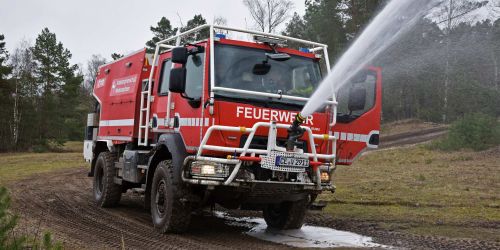
In both the fire engine and the equipment container, electrical control technology is indispensable for firefighting operations. A central PLC, complemented by numerous sensors, manages various control and regulation tasks on board. This includes flow sensors for extinguishing and controllers for proportioning pumps or blending systems. Displays are employed for real-time status updates and data logging, while additional sensors oversee the position of components such as outriggers or the ladder.

Garbage trucks
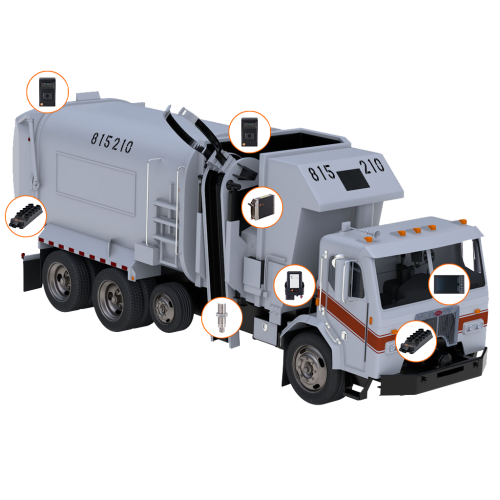
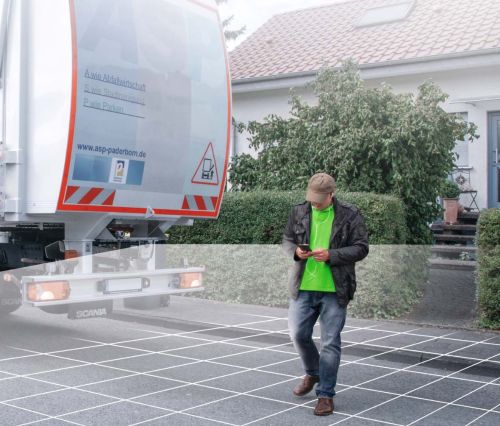
Modern side loader vehicles are being used for waste disposal in more and more cities. The driver drives parallel to the sidewalk on which the waste containers were previously placed. The waste containers are then automatically lifted, emptied and set down again by the side-mounted gripper arm. The mobile-friendly 3D sensor O3M ensures the necessary extra safety in the vehicles.

Compact sweeper
Despite their compact design, the sweeping vehicles are characterized by environmentally friendly technology and excellent sweeping performance.
This is achieved, among other things, through the use of ecomatmobile control technology. Cost-optimized control modules and compact dialog devices enable a system design tailored to the application.
Mobile-friendly sensors monitor machine functions and enable trouble-free operation. Inductive sensors report that the sweepings container has been locked correctly, and the fill level in the process water tank is recorded using a pressure transmitter.
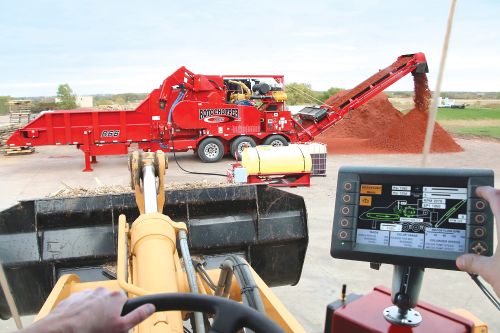
Mobile shredders in the recycling industry
In times of scarce raw materials, recycling technology is becoming increasingly important. Wood waste, tree pruning, building material or metal recycling: the optimal processing and sorting of the materials guarantees high recycling quality.
During the shredding process, extreme vibrations and shocks occur, which affect the built-in electronic components. For this reason, ecomatmobile components are tested under realistic conditions. Whether heat, water or dirt. The housings protect the electronics and withstand even extreme requirements. Electrical interference also has no effect on the control modules and thus on the machine functions.
Sensing
- Cameras: Mobile cameras are used for area protection as a backup assistant or to monitor the charging process and can react to an obstacle before the driver sees it, automatically halting the vehicle to avoid collision.
- Position: Inductive sensors, designed to ensure highest shock and vibration resistance, reduce failures from mechanical damage with extended sensing range.
- Encoders: Encoders for mobile use ensure precise positioning of the boom and transmit its position to the PLC.
Control
- Hardened PLCs: Automate functions with scalable I/O configuration. Two independent processors allow your machine to be SIL 2 certified.
- HMI controllers: HMI controllers have an integrated PLC for data visualization and data acquisition. The powerful interface between the machine operator and the central control technology via control buttons or touchscreen.
- ioControl: A centralized I/O module connected to the controller via CAN. Standardized screw or plug-in connections ensure a safe and easy connection of sensors and actuators.
- Cellular modem: Over-the-air (OTA) updates or online diagnostics of the machine software in close coordination between the machine operator and the manufacturer
- ISOBUS: Libraries are available for the ifm mobile controls that integrate the ISOBUS quickly and reliably into (already existing) applications.
- CODESYS software: Programming via CODESYS is clear and simple for the user. Function libraries are available for special hardware functions.