- Asset health management
- Predictive maintenance with root cause
- 3-axis vibration sensor
VVB 3-axis IO-Link vibration sensor: Technology
ifm’s VVB3 provides real-time machine health insights and predictive failure detection. Unlike typical analog MEMS sensors, which often require external signal processing, its digital MEMS chip communicates directly with the microcontroller. Onboard FFT processing minimizes data transmission requirements, while expanded memory stores up to nine days of historical data for trend analysis.
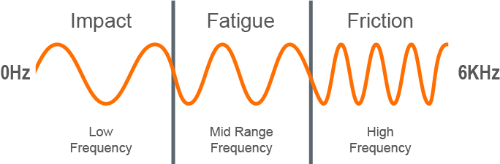
The VVB3 Data Science model provides detailed vibration data, transmitting 32 bytes of independent X, Y, and Z-axis measurements while using Impact (peak acceleration), Fatigue (average velocity), and Friction (average acceleration) indicators.
This model includes the BearingScout™ parameter, onboard H-FFT (Enveloped FFT) for bearing fault frequency monitoring in the frequency domain, enabling real-time detection of specific rolling element bearing frequencies for direct root cause analysis of failures. It also supports high-density time waveform capture, allowing for independent or synchronous X, Y, and Z-axis waveform data collection. The Data Science model can transmit the Time Waveform BLOB, providing raw vibration data for deeper diagnostics. This makes it ideal for:
- AI-driven analytics
- Advanced condition monitoring
- Process optimization.
Turning big data into actionable insights
Predictive maintenance relies on large datasets—vibration monitoring alone can generate up to 160,000 data points in 12 seconds. Converting time-domain signals into the frequency domain helps detect machine faults by identifying unique vibration patterns while filtering out noise.

ifm simplifies data analysis by transforming complex datasets into actionable insights. The VVB3 with IO-Link enables easy integration into existing control systems without requiring a separate network. Additionally, ifm’s Impact, Friction, and Fatigue indicators accelerate root cause identification. The sensor also supports rotational speed detection and onboard bearing fault frequency monitoring.
Advanced data processing with Y-path technology
For deeper analysis, Y-path technology captures raw vibration source data (Time Waveform) and sends it to higher-level software for automated frequency spectrum analysis and AI-driven monitoring.
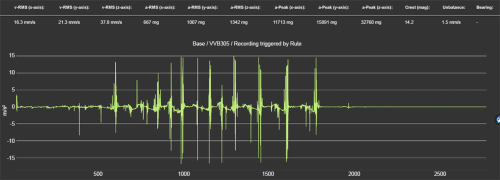
Screenshot of time waveform from Y path transfer to moneo evaluation software
Onboard trend history
ifm’s VVB3 can store up to nine days of vibration measurement history, eliminating the need for an external database. With ifm’s Y-path technology, trend history data can be uploaded directly from the sensor, reducing both integration programming and network bandwidth requirements.

Example of onboard sensor trend history data