Get reliable sensing for mixed colors, shapes, and materials
Production lines handling multiple materials lose efficiency due to missed detections and false triggers from optical sensors. These problems are common when objects with very different shapes, colors, or textures come down the same line, sometimes less than a second apart and closer than one inch to each other.
Common challenges:
- "Our targets vary from black to white, and our sensors miss products." Lighter targets reflect more light than darker ones. Two different-colored objects could be exactly 1000mm from the sensor, but the sensor reports completely different distances based on color.
- "My sensor does not see the same materials at the same distances." A white cardboard box appear closer than it is, while a black poly bag may appear farther away. Shiny stainless steel saturates the sensor with reflected light. Matte black rubber reflects almost nothing.
- "Darker parts are not detected as well as lighter ones." The detection range shrinks dramatically for dark targets compared to light ones. Dark materials absorb more of the light emitted by the sensor. Less light returns, so the sensor reads them as farther away than they actually are. Lighter materials reflect more, appearing closer.
- "My lighter parts are detecting further” / “Lighter targets trigger too soon." You calibrate for a dark part at one distance. When a lighter part passes through at that same position, it reflects more light back. The sensor interprets that stronger signal as a closer proximity and triggers early.
- "I have to keep recalibrating my sensors." / "I'm constantly changing my switch points." Each material and color needs its own sensitivity setting. Black rubber at one switch point. White plastic at another. Shiny metal at a third. Every material change means stopping the line to reprogram the sensor.
This isn't a calibration problem. It's how intensity-based optical sensors interpret reflected light. The O6D laser distance sensor from ifm overcomes these common challenges with new, patent-pending technology.
Why this happens
Diffuse and simple retroreflective sensors measure received light intensity and interpret that as distance. They do not output actual geometric distance value. A strong return signal gets interpreted as "close." A weak signal gets interpreted as "far."
Some optical distance sensors use triangulation or time-of-flight to measure distance but may still face limitations.
When you teach a sensor to detect a white plastic part, you're teaching it that a strong light return at a specific intensity means "trigger here." When a black rubber part appears at that same position, it reflects far less light.
The sensor has no way to know the part is at the same distance. Its programming says "weak signal = far away," so it reports a different distance or misses the part entirely.
Shape compounds the problem. A flat surface perpendicular to the sensor reflects light back to the sensor. An angled surface or curved edge scatters light in multiple directions. Less light returns to the sensor, even if the part is the same color and material.
The solution: Time-of-flight technology and instant recalibration innovation
The O6D laser distance sensor uses time-of-flight rather than light intensity. It measures what actually matters: how long it takes light to travel to the target and back.
Black rubber, white cardboard, shiny metal, matte plastic, and angled surfaces all trigger at consistent distances with no manual adjustment.
The pmd time-of-flight technology inside is phase-based, which sets it apart from standard intensity-based sensors. Rather than measuring how much light returns, the O6D measures the precise time interval until any reflected light returns.
The sensor's patent-protected detection engine continuously monitors for two conditions: saturation (shiny or white targets returning excessive light) and signal weakness (black or dark targets absorbing most light).
Once it identifies either condition, it recalibrates automatically. The sensor takes multiple readings at different exposures and blends them to capture the full range of the target's characteristics.
The process is similar to using the High Dynamic Range (HDR) setting on a cell phone camera.
That cycle completes in milliseconds, faster than products move through the detection zone.
More benefits
- Set up in seconds: The O6D only has two buttons: Out-On and Out-Off. Place your first product in front of the sensor, press Out-On. Remove it, press Out-Off. All calibration happens internally.
- No downtime for recalibration: The O6D laser distance sensor is a true plug-and-work, “set it and forget it” sensor that detects virtually everything that passes by with no adjustments needed.
- Cost- effective: Thanks to proprietary pmd technology, the O6D outperforms other optical sensors at a lower price point.
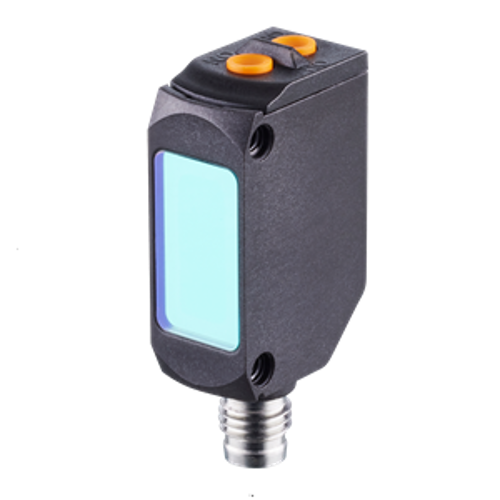
The O6D laser distance sensor in action
- In pharmaceutical packaging, a white HDPE container and a dark brown glass bottle can pass through the exact same conveyor position. The white container reflects strongly. The brown glass absorbs most of the light. The time interval is identical. The O6D reports the same distance for both.
- In automotive assembly, black wire harness connector housings and white connector housings can move through the same verification station. Traditional sensors calibrated for light colors miss dark components. Sensors calibrated for dark colors falsely trigger before light ones reach the verification point. The O6D detects both at the same distances.
- In metal fabrication, stainless steel and mild steel parts can move through the same inspection point — some clean, some oil-covered. The reflectivity varies dramatically. The O6D's time-of-flight measurement remains constant regardless of surface finish.
- A consumer goods manufacturer running seasonal packaging can deploy a single O6D sensor across their entire color range. Summer packaging in bright yellows, fall packaging in dark browns, winter packaging in deep reds — all trigger at consistent distances. Color-based reject rates disappear entirely.
- A plastics molding operation producing components in six standard colors can use the O6D at verification points. Black, white, red, blue, yellow, and clear parts trigger identically. Quality inspection accuracy improves. False rejects from color-triggered early switching are eliminated. Production managers can eliminate their calibration profile system.

