Stop optical sensor failures in harsh/changing environments

Production environments expose optical sensors to dust, moisture, oil mist, and other irritants. Lighting conditions often change throughout the day. These harsh or changing environmental conditions degrade optical sensor performance. They cause unreliable readings resulting in false positives and missing objects completely.
Common challenges
- "My sensor gets no signal because dust is blocking the light." Sawdust, grain dust, cement powder, or other fine particles accumulate on the sensor lens in minutes.
- "My sensor doesn't work in oily environments." Metalworking coolant mist, hydraulic oil vapor, or lubricant spray creates a sheen on sensor lenses.
- "I have issues with changing environment." Morning sunlight through windows floods the facility with natural light. Clouds roll in and ambient light drops 50%. Evening shift runs entirely under artificial lighting.
- "Not every part I look at performs the same." Variations in surfaces, finishes, and coating within normal manufacturing tolerances creates detection inconsistency. Parts from the same production batch trigger at different distances.
The problem isn't inadequate maintenance. Recalibrating sensors for changing lighting conditions causes significant downtime throughout the day. The challenge is that intensity-based sensors depend on clean optical paths and stable lighting conditions to function.
Instead, these environmental factors affect photo-eye detection due to specific limitations in optical physics. The O6D laser distance sensor uses laser point detection and continuous recalibration to avoid interference and account for changing conditions.
Why this happens
Since optical sensors measure reflected light intensity, they require clear optical paths and stable ambient light to send out light signals and receive them back.
Particles accumulating on the lens cause less light to leave the emitter and less reflected light reaching the receiver. The sensor interprets this weak signal as "target too far" or "no target present" even if the actual target hasn't moved.
Oil or moisture on lenses creates irregular refraction: Some light reflects off the contaminant layer rather than passing through to the target. Some scatters in random directions. The receiver gets intermittent or weak signals it can't interpret reliably.
Ambient light changes the baseline. Most sensors filter for their specific wavelength, but bright sunlight or powerful overhead LEDs can still influence the receiver's sensitivity threshold.
A sensor calibrated in low-light conditions may saturate when bright ambient light is added to the reflected signal.
Then, reflective surfaces compound all these issues. Oil-covered metal parts reflect intense light that can saturate the receiver.
The sensor set to handle matte finishes can't detect shiny surfaces suddenly returning ten times more light.
The solution: Laser point detection and time-of-flight technology
The O6D laser distance sensor measures the time light takes to travel to the target and return rather than light intensity. This time interval remains constant regardless of ambient light conditions or surface variations, and it increases the sensor’s sensitivity by 10x for better performance.
For dust, particles, and liquid-based contaminants, the O6D’s point laser penetrates dust and oil mist. The laser’s concentrated energy also cuts through airborne particles rather than being scattered by them.
The sensor automatically recalibrates for different light exposures in milliseconds to account for sudden or gradual changes in ambient light.
The O6D’s proprietary technology captures a burst of images at varying exposures the instant it detects something. This process is similar to the HDR setting on a cell phone camera.
It then sifts through those images to filter out excessive light or underexposure. This automatic recalibration process takes milliseconds, faster than a new object can arrive in its path.
The result is a sensor that works around accumulated or airborne particles, liquid mist or buildup, and varying lighting conditions.
More benefits
- Fast, simple setup: The O6D configures in seconds with no programming required. Press Out-On with your target in position. Remove the target and press Out-Off. Continuous automatic recalibration handles everything else – a true “set it and forget it” sensor.
- Universal detection: With reliance on time-of-flight and continuous automatic recalibration, the O6D reliably detects any object in front of it, regardless of its characteristics.
- Cost advantage: The O6D costs considerably less than comparable optical and time-of-flight sensors while delivering broader application coverage. The streamlined technology eliminates the need for multiple sensors at any switch point.
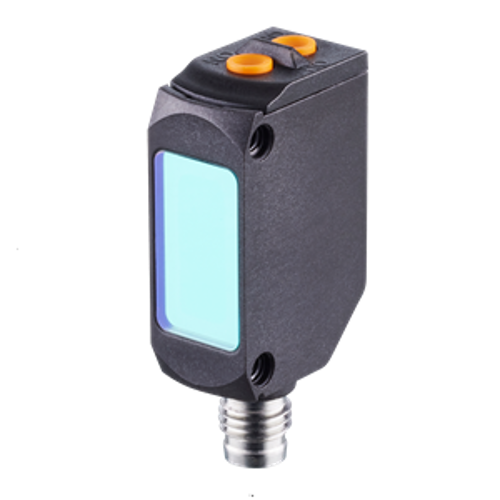
The O6D laser distance sensor in action
- In a sawmill, airborne sawdust fills the detection zone where sensors verify board presence on conveyors. The O6D's laser beam can penetrate dust cloud thats would block LED-based sensors. Monthly cleaning intervals can replace daily lens cleanings.
- A metalworking operation runs milling machines that generate coolant mist throughout the work area. Sensors verify part presence in fixtures before machining begins. The O6D can detect consistently on oil-covered aluminum, steel, and cast iron parts despite coolant residue on both the sensor lens and target surfaces.
- A pharmaceutical packaging line operates in a facility with large skylights. Sensors can verify bottle presence through clear shrink wrap packaging. Morning sunlight creates 50,000 lux ambient light. Afternoon clouds drop it to 5,000 lux. Night shift runs under LED arrays at 1,200 lux. The O6D maintains consistent detection across these lighting changes with no manual recalibration.
- A bulk aggregate operation conveys limestone, gravel, and sand. Sensors monitor material levels on conveyor belts where dust concentrations make optical sensing difficult. The O6D's laser penetration and PMD technology can deliver reliable detection for all materials.
- A food processing facility eliminates daily sensor cleaning from maintenance schedules entirely. The O6D can operate reliably with flour dust and oil mist that previously required multiple daily cleanings to maintain detection.
- A metalworking operation can eliminate false triggers with the O6D consistently detecting the full range of part surface conditions, from dry matte finishes to oil-saturated shiny surfaces.
- A packaging operation can eliminate separate sensor calibrations for day and night shifts. The single O6D setup works reliably from dawn through midnight under all lighting conditions without adjustment.

