End sensor downtime and recalibration on multi-SKU lines

Production lines that run multiple parts or SKUs lose efficiency due to optical sensor misreadings or additional downtime for sensor recalibration. A sensor can trigger too early, give a false positive, or miss something entirely, when objects with different shapes, colors, sizes, or materials arrive. Planned downtime and correcting inaccurate readings halt operations.
Common challenges:
- "My sensor does not see the same materials at the same distances." A white cardboard box may read as closer than it is, while a black poly bag reads as further. The white box reflects strongly, which gets mistaken for proximity. The black bag reads as further away because it absorbs more light.
- "My sensor works for the original product but fails when we introduce new SKUs." / “My production line sensor doesn’t see all products.” A sensor calibrated for one product locks its detection to that product's specific light return, color, and surface. When a new SKU with different characteristics hits the line, those locked settings are wrong. The sensor either misses it or false-triggers.
- “I have to keep recalibrating my sensors.” / "Sensor recalibration during product changeovers causes downtime." Each material and color needs its own sensitivity setting. When you add a new SKU or swap seasonal packaging, someone has to manually reprogram where the sensor triggers. On high-mix lines, that means stopping production multiple times a day.
- “I’m constantly changing my switch points.” Each product triggers at a different point based on how much light it reflects back. Black rubber at one distance, shiny metal at another. Every new product means a new switch point, and every switch point change means someone stopping the line to set it.
The problem isn't a faulty sensor. Rather, it’s the limitations of how intensity-based optical sensors work. The O6D laser distance sensor from ifm overcome these challenges with continuous, automatic recalibration and patent-pending time-of-flight technology.
Why this happens
Intensity-based optical sensors don't measure distance directly. Instead, they send out a light pulse and measure how much comes back. A strong return signal gets interpreted as "close." A weak one gets interpreted as "far."
When you set up a sensor for one product, you calibrate it for how much light that specific product sends back. That works until the new color, material, or surface finish on a different product changes the light return.
The sensor can’t tell that something changed, and now those setting won’t work. The only fix is stopping the line and reprogramming it.
The solution: Time-of-flight and continuous, automatic recalibration
The O6D laser distance sensor uses time-of-flight, rather than light intensity, to detect black rubber, shiny metal, matte plastic, and everything in between at consistent distance. It does so with no adjustments between products.
Its PMD time-of-flight technology is phase-based, which sets it apart from standard intensity-based sensors. Rather than measuring how much light returns, the O6D emits a laser pulse and measures the precise time interval between emission and return.
Its PMD time-of-flight technology automatically optimizes for whatever target is in front of it by recalibrating in milliseconds — faster than products move through the detection zone.
The sensor's patent-protected detection engine continuously monitors the incoming signal for two conditions:
- Saturation: When a shiny or white target returns too much light, and
- Signal weakness: When a black or dark target absorbs most of the light.
Once it identifies either condition, it recalibrates automatically by taking multiple readings at different exposures and blending them to capture the full range of the target's characteristics.
That entire cycle completes in milliseconds, faster than products move through the detection zone.
More benefits
- Two-button setup: The O6D configures in seconds with no programming required. Press Out-On with your target in position. Remove the target and press Out-Off. Continuous automatic recalibration handles everything else.
- Universal detection capabilities: The O6D is a true “set it and forget it” sensor because it requires no manual recalibration for different products or targets.
- Cost advantage: The O6D costs less than comparable time-of-flight sensors while delivering broader application coverage. The streamlined PMD technology eliminates the need for multiple sensor types across different detection scenarios.
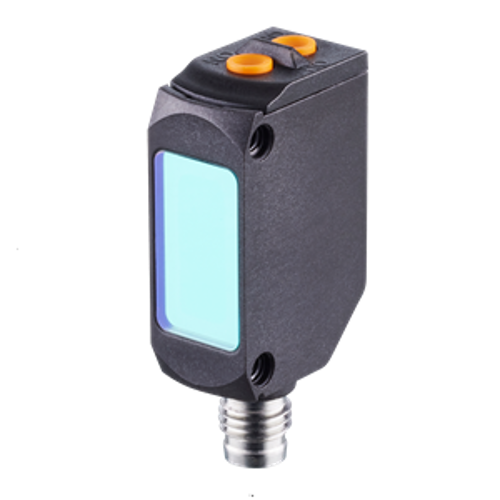
The O6D laser distance sensor in action
- In a distribution center, a black poly bag and a white cardboard box at the same distance return different amounts of light, but the travel time is identical. The O6D can report the same distance for both, because that's the actual measured distance.
- In tire manufacturing, a dense black cured tire and a green uncured tire at the same position on the conveyor can be measured at identical distances despite reflecting vastly different amounts of light.
- In automotive assembly, a black interior trim piece and a beige dashboard component can trigger detection at the same distance despite very different reflections.
- In pharmaceutical packaging, a white HDPE bottle and a dark amber glass bottle at identical positions return completely different light intensities, but the time-of-flight measurement will remain constant.
- An e-commerce fulfillment center can process mixed returns from multiple retailers (black poly bags, white corrugated boxes, brown kraft mailers, and clear plastic packaging) on a single sortation line.
- A consumer goods manufacturer running seasonal packaging can eliminate manual recalibration entirely. Summer packaging in bright colors, fall packaging in dark tones, and holiday packaging in metallic finishes all trigger consistently at the same detection point. Color-based production stops disappear completely.
- A pharmaceutical packaging line can handle multiple bottle types. Quality inspection accuracy can improve as false rejects from material-triggered early switching are eliminated.

