- SI sanitary flow sensors
- Setup and support
- Installation guidelines
SI sanitary flow sensors: Installation guidelines
For best performance of the SI family of flow sensors, please adhere to the following guidelines.
Should you need additional support, feel free to contact our service center at 888-704-0702 and speak to one of our applications engineers.
Insertion depth
As seen in the Technology section, the SI sensor monitors the difference in temperature of two RTDs – one located at the tip that reacts as the flowing medium conducts heat away, and one located ~12 mm above that provides the medium reference temperature.
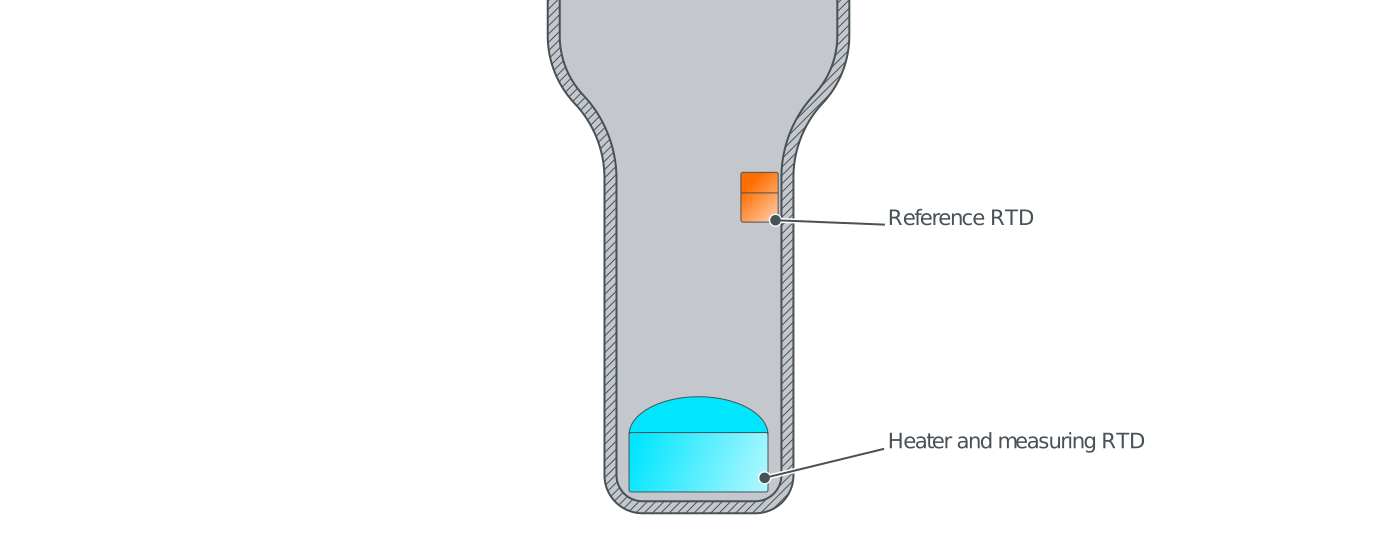
To account for any medium temperature changes, the tip of the sensor must be located within the flowing medium. Be sure to take this into consideration when choosing your mounting accessories.

Pipe mounting
To help ensure the sensor tip is surrounded by the medium, always mount the sensor in a vertical section of pipe with flow going up. This method guarantees the pipe is full. If horizontal mounting is the only option, mount at an angle in case the pipe may not be full.

Recommended mounting
If the pipe is guaranteed to be full, the sensor may be mounted from the top.
Because of the principle of operation, build-up on the sensor tip affects heat conduction. If the medium is free from build-up, horiztonal mounting from the bottom is possible.
Be sure to thoroughly test the sensor in these situations.

Conditional mounting
Two mounting situations that are not recommended in any case are:
- Sensor tip in contact with the opposite pipe wall. This will adversely affect the heat conduction process.
- In a pipe with downward flow that is open to atmosphere and not a closed loop system. The velocity profile in such a situation is not repeatable.

Not recommended
Straight pipe run
The SI sensor is the most reliable and repeatable when the sensor is installed in laminar flow. Valves, bends, flow constrictions, etc. all cause turbulence.
To avoid influences of turbulence, maintain a straight run of 5...10 x pipe diameter upstream of the sensor and 3...5 x pipe diameter after the sensor.
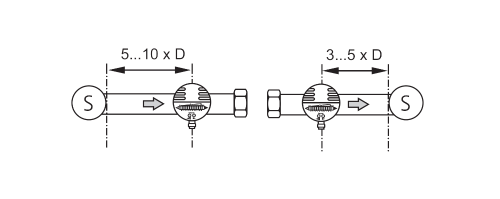
D = pipe diameter, S = source of turbulence
Sanitary installations with 3A authorization
The SI family of sanitary flow sensors uses a flexible process connection system known as Aseptoflex Vario. One part of this system is an o-ring seal between the sensor and the process medium. We offer o-rings in FKM and EPDM elastomers as well as a PEEK sealing ring. This PEEK ring provides longer stability compared to traditional elastomers that become hard and brittle over time.

The second part of the sealing system required for 3A authorization is leakage ports, or weep holes. When an o-ring is in place (see above), the process medium will remain in the tank or pipe. If that o-ring is compromised, i.e., missing or damaged, the process medium will leak at the weep hole. This is an indication that the o-ring must be replaced.


Clamp fittings (typically triclamp or varivent)
- Pressures of 16 bar are acceptable only when a high pressure clamp (bolted) is used.
- Follow the guidelines below for proper installation.

1 = Leakage port. To avoid dead spaces, L < (D - d).

Avoid mounting position #5 so that the medium does not build up on the probe
Weld fittings
- Use weld mandrel to prevent warpage during welding
- Use arrow to indicate display orientation
- When cleaning up welds, make sure not to damage sealing edge of adapter. This will cause leaks.

Align the mark on the fitting (1) with the final orientation of the sensor display