Jungheinrich – Mobile robots shaping the future of intralogistics
AMRs with vision: seeing more, acting autonomously
How Jungheinrich is accelerating mobile robotics with ifm’s O3R 3D camera platform
Jungheinrich has been a leading provider of intralogistics solutions for more than 70 years. Alongside its established manual intralogistics portfolio, Jungheinrich is placing a strong focus on automation. The company is consolidating its robotics expertise and uses the ‘Home of Mobile Robots’ showroom at its site in Eching near Munich as a dedicated space for hands-on customer interaction.
“Customers need to experience mobile robots and engage with them directly. This hands-on approach is essential – for us, for our customers, and for the future development of automated intralogistics,” emphasises Manuela Schmidbauer, Portfolio Manager Mobile Robots at Jungheinrich.
Greater autonomy in brownfield environments
Intralogistics requirements have changed considerably. Customers in manufacturing, retail and logistics are looking for solutions that address labour shortages and cost pressure without adding complexity to their processes. Autonomous mobile robots (AMRs) must be integrated into brownfield environments – existing facilities where mixed operation is the norm. “A high degree of autonomy and intuitive interaction with the vehicles are key requirements,” explains Manuela Schmidbauer. AMRs operate side by side with operators of manual vehicles, conveyor systems and pedestrians. This creates demanding requirements in terms of perception, safety and responsiveness. “Our vehicles must keep pace with the capabilities and responsiveness of human operators,” says Schmidbauer.

Agile development requires agile partners
To respond quickly to these market requirements, Jungheinrich develops its solutions in close collaboration with customers, using agile methods and shorter development cycles than in the past. “This requires partners who can keep pace with this level of dynamism,” Schmidbauer continues. “With ifm as an automation specialist, we have found a partner that provides suitable sensor and control solutions for our mobile robots.”
Greater perception thanks to the O3R platform
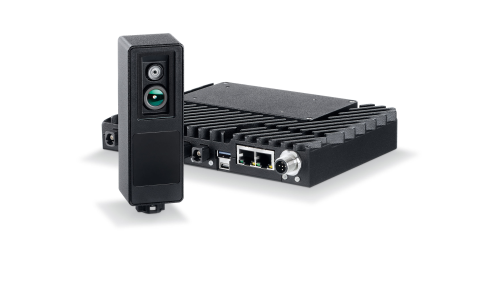
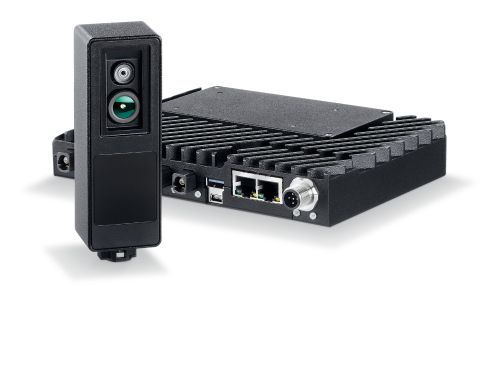
With the EAE 212a, Jungheinrich is introducing its latest generation of AMRs, designed to enable even greater autonomy while noticeably simplifying the integration of these vehicles into customers’ existing processes. A central element of this AMR is the O3R platform from ifm. The O3R system comprises a central Video Processing Unit (VPU) capable of connecting up to six 2D/3D camera heads. The VPU synchronously processes the image data and, in conjunction with algorithms developed by Jungheinrich, enables reliable detection of load carriers and other objects.
Powerful dual control unit
In the EAE 212a, Jungheinrich relies on ifm’s ecomatController CR710S featuring a total of 37 inputs and outputs. The controller is not only highly robust against vibration, heat and cold, but also offers high performance. A 32-bit microcontroller ensures short cycle times. In combination with its large program memory, it reliably and efficiently executes even complex algorithms. Another advantage is that the ecomatController combines two independent PLCs in a single device: one handles standard control tasks, while the other is dedicated to safety applications and is TÜV-certified up to SIL 2 or PL d.


Image 1: Practical scenario: AMRs must also operate reliably in mixed operation with manually operated vehicles.
Image 2: Two camera heads facing the direction of travel capture a wide view of the area in front of the AMR.
Image 3: The Jungheinrich AMR recognises pallets extremely reliably thanks to the O3R camera head (centre of image).
Robust PMD point cloud for pallet detection and obstacle detection
“We use the O3R for two core functions: pallet detection and obstacle detection along the travel path,” explains Sebastian Gangl-Spethmann, Senior Development Engineer at Jungheinrich. Two cameras are mounted in the direction of travel, while an additional camera monitors the load area at the rear. In both cases, the AMR benefits from the point cloud generated with high precision by the camera heads using PMD technology: “We reliably detect pallets, even when they are offset or rotated. The AMR can approach and pick them up consistently.” This robustness increases flexibility in warehouse processes by allowing pallets to be handled reliably even when they are not placed with millimetre precision.

3D point cloud and 2D image: Comprehensive visual information is available for load acceptance thanks to the O3R platform.
Improved environment perception compared to safety scanners
Thanks to the two forward-facing cameras used for obstacle detection, the EAE 212a operates with predictive navigation rather than reactive stop-and-go behaviour. “The required safety laser scanners reliably detect people, but they have the limitation that they operate only in a single plane and close to the ground,” explains Gangl-Spethmann. “The 3D cameras monitor a much larger area in front of the vehicle. This allows us to detect people at an earlier stage. In addition, the 3D cameras also detect elevated objects protruding into the travel path, such as forks or crane hooks, in time to avoid them and continue driving without stopping. This increases throughput and reduces process times.”
More robust information than 3D LiDAR systems
Compared to 3D LiDAR systems, the 3D cameras used also provide reliable object detection on reflective surfaces. The additional 2D stream enables more precise segmentation and visualisation of the captured scene. “Overall, this gives us more information to achieve robust object detection,” summarises Gangl-Spethmann. This broader data basis enables more reliable detection and handling of objects across a wide range of environments – a decisive factor for flexible use in real-world applications.
Robust perception, smooth traffic flow, fast integration
A key development objective was to simplify commissioning of the AMR at the customer site. Thanks to the interfaces and tools provided with the O3R platform, the system is ready for operation quickly – including extrinsic calibration and basic configuration. For operators, this means shorter downtime during rollout, reduced engineering effort and predictable scalability.
O3R: capacity for future AMR evolution
The O3R platform itself is designed to grow with changing requirements: additional fields of view, extra cameras or new function modules can be added step by step, without the need to rethink the overall system architecture. For Jungheinrich, this technical foundation supports a key objective: designing human-machine interaction to be safe and intuitive. “The requirements of our customers will continue to evolve as automation and autonomy increase,” says Manuela Schmidbauer. With the EAE 212a, Jungheinrich anticipates this change – and ifm’s sensor technology provides the necessary depth of environmental understanding that is crucial in brownf ield environments.
Partnership as a key success factor
The close cooperation between Jungheinrich and ifm electronic was a key factor in the success of the project. “The collaboration with ifm is very good,” says Gangl- Spethmann. “For important topics, we can get in touch with the developers quickly, which allows us to resolve even technically complex questions without delay.” This direct line between the development teams of both companies enables short decision-making paths and fast solutions – a decisive advantage in a dynamic market environment shaped by rapid technological change.