- Level sensors overview
- Point level sensors LM
Type LM point level sensors
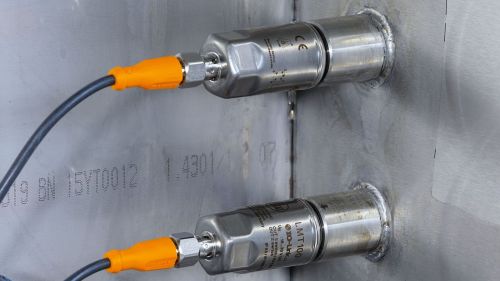
The point level sensors of the LM series provide a reliable solution for level monitoring across a wide range of applications. Whether used for overflow prevention, leakage detection, or run-protection, the sensors consistently ensure a high level of accuracy and safety.
To meet different requirements, variants are available for both industrial environments and hygienic applications. The sensors reliably detect a broad spectrum of media – from water-based liquids and oils to powders – regardless of whether the medium is liquid, solid, or viscous.

The reliable alternative to tuning forks
Conventional vibrating forks quickly reach their limits with viscous or adhesive media. Buildup can distort measurement results and trigger incorrect switching. The smoothly rounded measuring tip of the LM sensors minimises buildup from the outset and reliably suppresses any remaining deposits. This keeps the measurement precise, even under demanding process conditions.

Reliable media differentiation
With two independently programmable switching outputs, the sensor reliably distinguishes between different media. This enables early leakage detection in applications such as heat exchangers – for example when water enters an oil circuit. This precise differentiation increases process reliability and prevents consequential damage.

Fast and flexible integration
Different device versions with various installation lengths and process adapters allow simple and flexible integration into almost any system. The device versions are factory-preset for specific media such as water or oils, significantly reducing installation time.

Industry-appropriate design
The sensors all feature a robust stainless steel housing. The LMC and LMT versions are equipped with a durable PEEK tip, while the LMH version features a ceramic tip that reliably withstands temperatures up to 250 °C.
The sensor is insensitive to deposits on its surface. Incorrect switching that could lead to tank overflow or pump dry-run conditions is reliably avoided through effective deposit suppression.
Products in comparison
| LMT | LMH | LMC | |
|---|---|---|---|
| Area of application | Industrial and hygienic applications | Industrial and hygienic applications | Industrial applications |
| Sealing concept | Hygienic PEEK metal | Hygienic O-ring (available separately) |
Rear flat seal |
| Presetting | Water-based media, viscous media and oils | Water-based media and oils |
Hydrous media |
| Max. medium temperature | 100 °C up to 150 °C for 1 h |
250 °C | 100 °C |
| Integrated temperature measurement |  |
 |
|
| Deposit suppression | |
|
|
| Measuring tip material | PEEK | Ceramics (99.97 %) | PEEK |
| Approvals | FDA, EHEDG, 3A, KTW/W270, EC 1935/2004, ACS, Reg31, FCM | FDA, EHEDG, 3A, FCM, ADI Free, USP Class VI, ASME-BPE, CRN, cULus | DNV |
Overflow prevention
To prevent tanks and containers from overfilling, point level sensors can be installed at different heights. The medium supply is stopped as soon as the upper level sensor reacts, and resumed when the level drops to the lower sensor. This ensures continuous control of the process, preventing the tank from overflowing or running empty and maintaining safe operation.
The sensors are insensitive to deposits and operate reliably even under challenging conditions, contributing to efficient processes.
Run-dry protection
To ensure reliable operation and long service life of pumps, run-dry conditions should be avoided. This is exactly where the point level sensors provide a simple and effective solution: As soon as the measuring tip is no longer covered by the medium, the sensor detects this and sends a signal to automatically switch off the pump. This prevents damage caused by dry running and extends the service life of the system.
Once enough medium is present again and the sensor is fully damped, the pump restarts. This ensures safe and smooth operation.
Leakage detection
The LM type point level sensors can support early detection of leakages in closed systems. If, for example, a leakage occurs in heat exchangers, water may enter the otherwise closed oil circuit. With two independently programmable switching outputs, the sensor reliably distinguishes between different media, allowing the leak to be detected and addressed at an early stage.

