How radar sensors work: Technology and application guide
Radar is an all-weather solution that tolerates extreme temperatures and functions across varied lighting conditions. Unlike optical sensors and other technologies, radar maintains accuracy and consistency in challenging environments. Radar sensors are non-contact, operate reliably in all weather conditions and resist environmental interference. They are known for their robustness, precision, and flexibility, making them ideal for diverse applications.
Radar has been a critical tool in mobile and industrial applications for over 50 years. Other technologies have achieved superior precision and complex area mapping in the past two decades. But radar remains versatile, robust, and cost-effective for area and distance measurement and monitoring. It is the most reliable solution for harsh environment penetration.
Many professionals can perform basic radar sensor tasks in mobile and industrial environments, such as calibrating and installing them, reading outputs, and applying the data. Knowing how radar sensors work, and understanding the technologies that power them, unlocks significant benefits:
- Increased efficiency, performance, and reliability
- Efficient maintenance and troubleshooting, reduced downtime
- Advanced automation uses, innovative configurations and applications
This guide provides an in-depth tutorial on radar sensor technology, types, operation, recent innovations, and a detailed exploration of their benefits.

Radar has a wide range of applications, including:
- Aviation
- Meteorology
- Maritime navigation
- Traffic control
- Object detection in the industrial world

Radar sensors provide cost-effective solutions for:
- Distance measurement
- Area monitoring
- Motion and object detection
- Collision avoidance
- Driver assistance in challenging conditions
- Ground speed detection
Radio waves detect, locate, and track objects
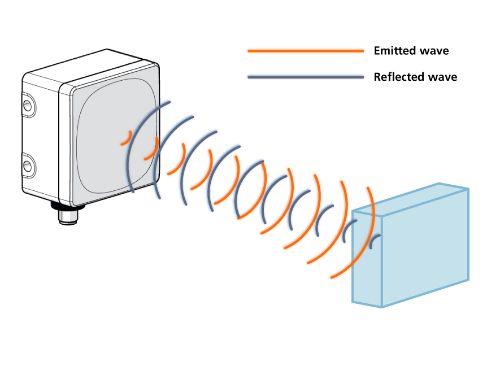
Radar, which stands for Radio Detection and Ranging, is a technology using radio waves to detect, locate, and track objects. The basic principle behind radar involves transmitting radio frequency (RF) signals, or waves, and receiving their reflections back from objects in the radar path.
The round-trip time for the waves is also known as time-of-flight. That time provides information about object presence, distance, velocity, and direction through signal analysis.

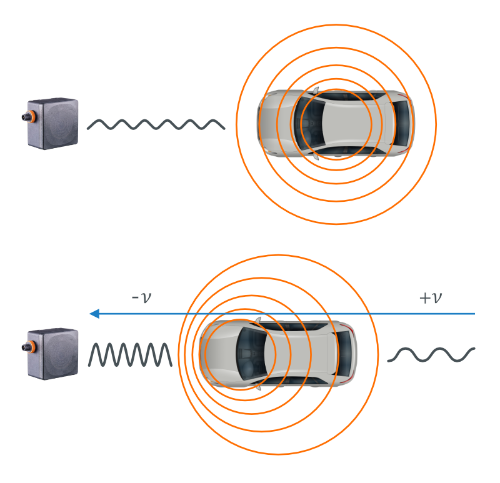
The Doppler effect
Radar sensors use the Doppler effect to measure the speeds of moving objects. The Doppler effect is the apparent frequency change in a wave when the source and observer move relative to each other. Frequencies increase as objects approach each other, and lower as they move apart.
Radar also uses the Doppler effect to determine a target’s velocity (a vector quantity indicating speed and direction). When targets move toward or away from the sensor, reflected RF signal frequencies change accordingly. Greater shifts indicate faster movement.
Radar sensor components
-
The transmitter generates electromagnetic waves in the microwave frequency range. Emitted radio waves travel through the air at the speed of light, imperceptible to humans.
-
The antenna emits these radio waves and receives the signals. Various systems use single antennas for both functions, dedicated antennas for each, or sophisticated antenna arrays for expanded coverage.
-
The receiver filters out noise from the returning signals and prepares them for processing.
-
The signal processing unit analyzes returning signals for object information.
The display unit presents a visual representation of the processed object information about detected objects for human interpretation. Not all radar systems include this feature.
Radar sensor technologies
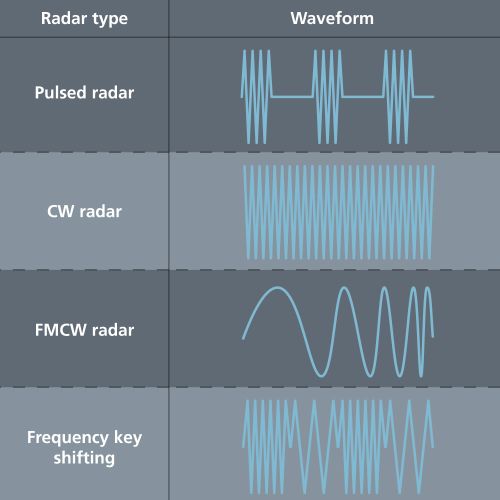
Various radar technologies enable different industrial and mobile applications:
- Pulsed radar emits short bursts of high-frequency radio energy and measures return time from targets.
- Continuous wave (CW radar) continuously transmits a known, stable frequency signal and measures Doppler shift in returned signals.
- Frequency-Modulated Continuous Wave Radar (FMCW) transmits continuously varying frequency signals and analyzes frequency changes in received echoes versus transmitted signals.
- Frequency shift keying switches between two or more signal frequencies to determine range and velocity by analyzing differences in each one’s received signals.
- Deep Dive Continuous Wave Radar (CW) provides advanced analysis of standard CW radar through continuous transmission and Doppler shift.
Measurements
Radar sensors use advanced signal processing for precise distance, velocity, and direction measurements:
- Distance: Calculated from reflected signal time delay. Since radio waves travel at light speed, return time directly corresponds to object distance.
- Velocity: Determined through Doppler effect motion detection. Doppler analysis determines moving target velocity by examining reflected wave frequency shifts.
- Direction:Achieved through antenna arrays and phase differences. Comparing phase differences between signals received at multiple antenna elements enables precise determination of reflected signal arrival direction.
Varying radar dimensionalities provide different measurements:
- 1D radar measures one characteristic, usually velocity, using CW technology or distance using pulsed technology. Without distance or angular resolution, it cannot separate multiple objects with identical velocity.
- 2D radar commonly measures velocity and distance using FMCW or FSK technology.
- 3D radar measures distance, velocity, and angle (direction or object orientation) in three-dimensional space using antenna arrays.
Narrow beam vs. wide beam radar
Wide beam versus narrow beam radar refers to frequency ranges over which transmitters send pulses or continuous waves. It is determined by antenna design and aperture size as well as beamforming techniques.
- Narrow beam radar technology features 1-10 degree beam angles, delivering superior precision and resolution. This focused configuration enables single-axis measurement, providing length-based data detection. Through length measurement, these systems identify object presence, determine sensor-to-target distances, and calculate velocity for approaching or retreating objects. These sensors are often called "radar distance sensors."
Typical applications:
- Precise distance measurement
- Level detection of liquids or bulk materials
- Object detection
- Speed measurement'
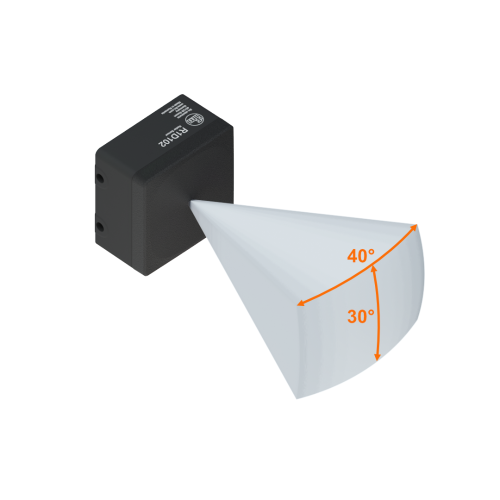
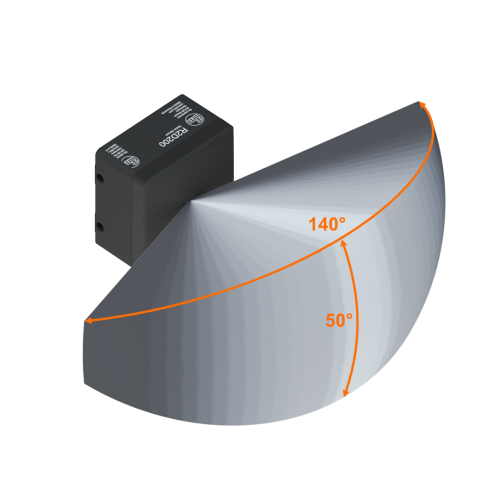
- Wide beam radar technology operates with beam angles exceeding 10 degrees, offering expanded coverage for dual-axis measurement combining length and depth data. This broader detection zone facilitates enhanced object identification and spatial positioning in three-dimensional environments, though with reduced resolution compared to narrow beam systems. These sensors are frequently called "radar area sensors."
Typical applications:
- Area monitoring
- Collison avoidance
- Driver assistance and blind spot monitoring in challenging conditions
- 2D/3D profiling
Radar resolution, or separability, is a radar's ability to distinguish closely-positioned targets as separate objects. When targets have similar measured values, sensors may fail to detect them individually.
- Distance resolution depends on transmission signal bandwidth, enabling object differentiation based on distance differences. Objects at similar lateral and elevation angles can still be separated reliably based on their mutual distances.
- Angular resolution describes differentiation capability based on target angle information. This includes azimuth resolution (lateral angles) and elevation resolution (elevation angles). Objects farther from the sensor require greater separation distances for reliable detection.
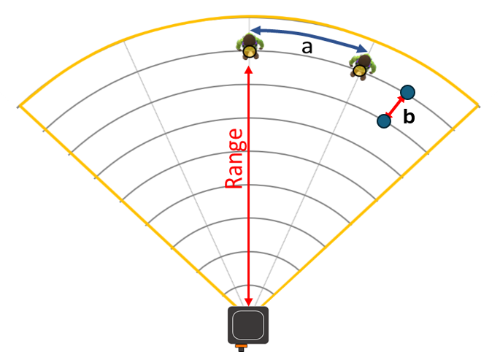
A= Angular resolution B= Distance resolutions

Radar cross-section (RCS)
Radar cross-section (RCS) describes how detecible an object is for a radar sensor. The more detecible an object is, the further away it can be detected. RCS value is based on the target's characteristics including size, orientation, dielectrical constant, material, and coating.
Dielectric constant
An object's dielectric constant measures its ability to store electric energy in an electric field. Higher dielectric constants and larger object sizes produce higher RCS, improving radar visibility and maximum achievable range.
High dielectric constants cause electromagnetic signals to bounce off objects and return to the sensor. Low dielectric constants allow signals to pass through, preventing detection.
Low dielectric constant:
- Air
- Dry paper, cotton, textiles
- Certail plastic material (e.g. PP, PS pellets, PTFE)
- Wood
- Gasoline, engine oil, vegetable oils
Medium dielectric constant:
- Concrete
- Glass
- Ceramics/porcelain
- Natural rubber
- Dry sand
High dielectric constant:
- Water
- Glycerin
- Alcohol (methanoal, ethanolm IPA, glycerol, etc.)
- Materials used in electrical components (barium titanate, hafnium oxide, titanium dioxide, zirconium oxide, aluminum oxide, etc.)
- All kinds of metals
3D cameras and LiDAR surpassed radar in precision and object detection over the past decade. Innovative radar sensors now compete again through millimeter-level accuracy, reliable detection of low dielectric materials, and comprehensive object recognition, while maintaining their advantage in harsh environments and lower price points.
FMCW technology advantages
Contemporary radar systems utilize frequency-modulated continuous wave (FMCW) methodology. It outperforms conventional systems by enabling multi-parameter measurement through frequency modulation rather than temporal delays. This improves radar performance in close-proximity industrial and mobile applications. It also enables 4D radar.
4D radar measures range (distance), elevation (vertical angle), azimuth (horizontal angle), and velocity and generates high-resolution point clouds. These aspects improve object classification, resolution, and accuracy. It also works in low-light, precipitation, and extreme temperature environments.
4GHz bandwidth benefits
Radar sensors with 4GHz bandwidth provide significantly improved resolution and measurement precision compared to 1GHz systems. The expanded frequency range enhances distance resolution and supports advanced signal processing. For example, while 1GHz systems cannot distinguish two objects separated by three centimeters, 4GHz systems can resolve the gap between them.
However, increased information gathering increases signal distortion and background noise. Therefore, 4GHz radars typically include advanced digital signal processing (DSP) to address noise.
Engineers, maintenance managers, technicians, operations managers, and quality assurance officers can easily set up and utilize radar sensors across various applications. However, understanding their underlying technologies and operation significantly increases efficiency and effectiveness.
Informed sensor selection
Radar sensors may experience interference or false readings from specific obstructions, materials, or electromagnetic noise. Understanding microwave principles, such as frequency bands, modulation methods, and beam patterns, allows you to match the right sensor to your application and environment.
Optimized configuration and application
Default parameters enable easy installation but may create blind spots and false alarms. Understanding radar's physical principles allows fine-tuning sensitivity and filter settings for accurate object classification. This knowledge also enables sensor fusion, combining radar with LiDAR or 3D cameras for advanced real-time obstacle detection and avoidance.
Efficient maintenance and trouble shooting
Understanding radar sensor operation simplifies root-cause analysis for non-detection or erratic readings. Basic knowledge of signal processing, microwave propagation, or shielding helps distinguish between software glitches, environmental effects, and hardware faults. Understanding signal strength and noise trends enables early identification of sensor degradation and failure signs.
Innovation and advanced automation
Rapidly evolving fields like mobile robotics and autonomous off-highway vehicles constantly generate new applications, while radar technology itself advances quickly. Understanding radar functionality enables adaptation to emerging use cases, new challenges, and integration into advanced systems.