Choosing a radar sensor: Step-by-step guide
Radar sensors are often the best choice for long-distance measurements and measurements in harsh conditions. To choose the right radar sensor technology, follow these steps to determine:
-
Whether the radar will focus on an object (narrow beam) or monitor a larger area (wide beam).
-
The approved operating frequency for your application (e.g., 60GHz for industrial; 77GHz for mobile)
-
The communication protocol the sensor should use (e.g., IO-Link; CAN J1939)
-
What type of raw format is needed (e.g. raw point-cloud, object list or digital and analogue outputs)
This step-by-step guide explores how different radar sensor technologies and specifications match various applications and facility infrastructure. The guide outlines the decision-making process and then applies it to ifm’s radar sensor offerings.
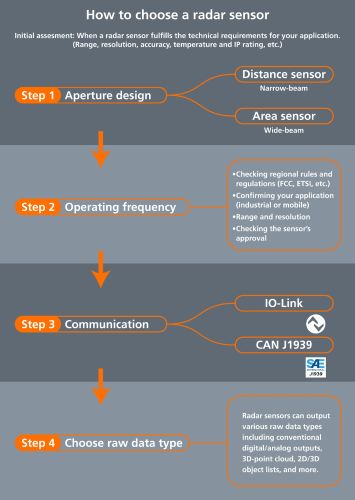
With a quick primer on radar technology, it’s easy to determine:
-
Whether to choose narrow beam or wide beam
-
Which operating frequency to use
How radar works
Radar works by sending out radio waves and analyzing the reflection to determine the distance, traveling direction, and velocity of objects. Resolution is lower at longer ranges: Radar can’t distinguish small objects or objects very close together as well as at shorter ranges.
Narrow beam radar vs. wide beam radar
Radar emitting a very narrow beam or radio waves has better resolution than a wide beam, but it covers a smaller area. A wide beam covers a larger area but has less range and resolution.
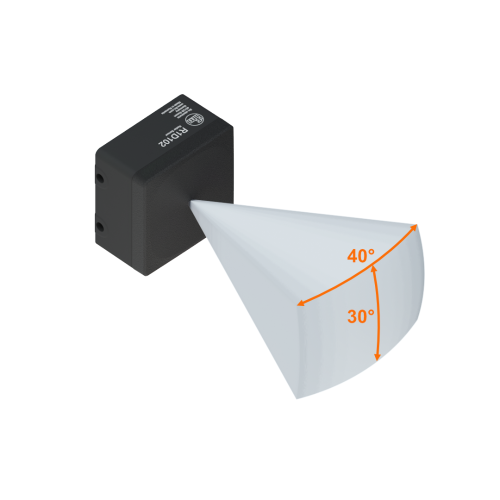
Narrow beam radar provides excellent resolution and accuracy, but only one dimension of measurement: Length. The beam usually has an angle of less than 40-50 degrees. However, the angle may be greater depending on atenna design.
Measuring length can reveal the presence of an object, its distance from the radar sensor, and its speed if it is moving toward or away from the sensor. Narrow beam radar sensors are sometimes referred to as “radar distance sensors.” In mobile and industrial applications, they are ideal for:
-
Object detection
-
Distance measurement
-
Level measurement
-
Speed measurement on a conveyor
-
Ground speed measurement
-
Height measurement and control
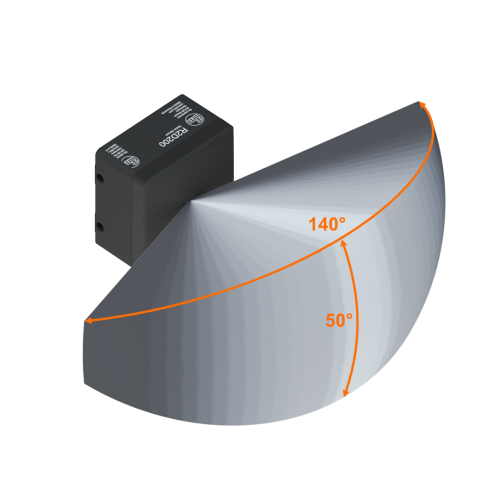
Wide beam radar measures depth along with length for better object recognition and placement in three-dimensional spaces. However, it has lower resolution than a narrow beam antenna. The opening angle is typically more than 100 to 180 degrees horizontally and 10 to 30 degrees vertically.
Wide beam radar sensors are sometimes referred to as “radar area sensors.” In mobile and industrial applications, they are ideal for:
-
Obstacle detection
-
Collision avoidance
-
Lane assist
-
Area monitoring
-
Gate monitoring
-
Truck docks monitoring
The next steps to choosing a radar sensor depends on application needs and a machine's control architecture.
Operating frequency for industrial vs. mobile applications
All commercial radar transmitters must be approved and certified by government agencies. FCC regulations dictate that radar sensors use specific operating frequency depending on their use. The regulations stem from the pros and cons of different frequencies and the need to limit interference between electronic devices sharing the radio wave spectrum.
As a rule of thumb:
- Industrial use: The radar sensor is mounted on a static or startionary locations
- Mobile use: The radar sensor is mounted on a moving vehicle/mobile equipment
All operating frequencies are approved to be used indoors and outdoors. Data transmission requirements, resolution, and range also apply.
24GH, 60GHz, 77GHz, and 122GHz are most commonly used radar frequency bands for industrial and mobile sensing. Different frequency bands offers different performance and has its pros and cons.
Industrial radar sensors from ifm operate at 60Hz. This frequency is best for rapid data transmission and high bandwidth over short distances. These sensors are usually used for short-to-mid-range applications in a factory such as:
- Distance measurement
- Level measurement
Mobile radar sensors from ifm operate at 77GHz, which is better for long-range measuring. These sensors are usually mounted on vehicle. They are usually used outdoors, and commonly for mid- to long-range applications sucah as:
- Off-highway vehicles (e.g. construction and agriculture)
- Automated guided vehicles (AGVs) in warehouses
Communication protocols
Industrial and mobile radar sensors use either the IO-Link or J1939 communication protocols. Industrial radar sensors are usually equipped with simple digital and/or analog outputs.
Point cloud data is raw information about what the sensor observed. A maximum of 128 points (reflections) can be outputted. A user would need to run their own scripts or programs to interpret the data.
Choose point cloud if your facility’s data analysts run their own scripts or programs on raw data.
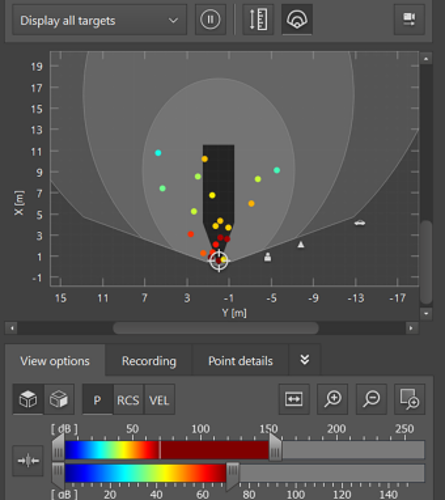
Typical uses:
- 2D profiling of objects (e.g. volume estimation of material in a large container)
- Obstacle mapping in a warehouse or outdoors.*
Object lists automatically match sensor data with templates to identify objects based on those established profiles.**
Choose object mapping depending on whether your facility respectively uses software with built-in object templates.***
With the sensor’s algorithm, when a radar sensor detects multiple points (reflection) that are close-by, the sensor groups them together to form an object.
Within the sensor’s FoV (Field of View), the sensor can output a list of detected objects. Each object has parameters such as distance, position, velocity, signal strength, confidence, etc.
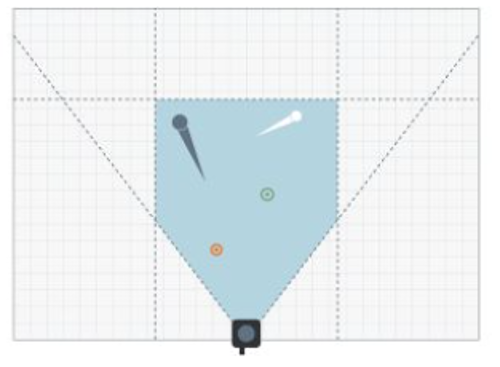
This is essential for collision avoidance, object tracking and multiple obstacle detection.
ifm’s radar sensor family provides more than simple digital and analog outputs.
- IO-Link version: Process values including continuous distance, velocity, signal strength (Power & RCS), and diagnostic outputs.
- CAN J1939 version: Process values, ROI (Region of Interest), zone, signal strength (Power & RCS), details of points/objects and diagnostic outputs.
*The sensor is not a safety device and the resolution and number of points aren’t designed for high-density area scanning.
**Radar sensors from ifm that use IO-Link can either provide 3D point cloud data or an object list. ifm radar sensors using J1939 can provide both.
***Vision Assistant software from ifm uses patented object recognition with templates to recognize dozens of pre-loaded objects and materials using object list data.
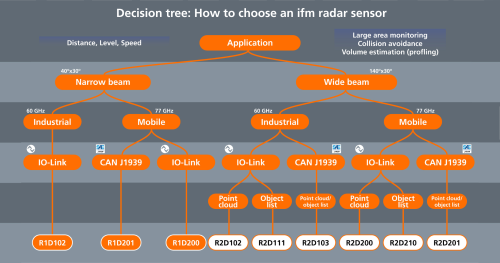
The innovative technology in ifm radar sensors makes them more powerful and versatile than traditional sensors while retaining radar’s relatively low cost:
-
4GHz bandwidth range allows ifm radar sensors to detect smaller objects with greater accuracy, range resolution, and precision than the standard 1GHz range.
-
Frequency-modulated continuous wave (FMCW) technology allows ifm radar sensors to measure multiple kinematic qualities, such as distance and velocity, at the same time. It also improves precision and resolution, particularly at short ranges.
- A wide range of sopening angles, communication protocol, and output functions for all your applications needs.
Guide to ifm radar sensor product lines
Click each model number below the table below for more information or to purchase.
| Radar sensor model | Band | Application | Operating frequency | Communication protocol | Data output |
|---|---|---|---|---|---|
| R1D102 | Narrow beam | Industrial | 60GHz | IO-Link | Point cloud, object list, IO-Link process values or Analog + Digital output |
| R1D201 | Narrow beam | Mobile | 77 GHz | CAN J1939 | Point cloud, object list |
| R1D200 (Available soon) |
Narrow beam | Mobile | 77 GHz | IO-Link | Point cloud, object list, IO-Link process values or, Analog + Digital output |
| R2D102 (Available soon) |
Wide beam | Industrial | 60GHz | IO-Link | Point cloud, object list, IO-Link process values or, Analog + Digital output Object list |
| R2D111 (Available soon) |
Wide beam | Industrial | 60 GHz | IO-Link | Point cloud, object list, IO-Link process values or, Analog + Digital output Object list |
| R2D103 (Available soon) |
Wide beam | Industrial | 60 GHz | CAN J1939 | Point cloud, object list |
| R2D200 | Wide beam | Mobile | 77 GHz | IO-Link | Point cloud, object list, IO-Link process value or, Analog + Digital output Point-cloud |
| R2D210 (Available soon) |
Wide beam | Mobile | 77 GHz | IO-Link | Point cloud, object list, IO-Link process values or, Analog + Digital output Object list |
| R2D201 | Wide beam | Mobile | 77 GHz | CAN J1939 | Point cloud, object list |