Cone crusher protection
What are the challenges in monitoring and protecting crushers?
- Today, crushing automation is already a reality in the mining industry, bringing many benefits to the process, such as improved operational control using process data to increase production performance. Using predictive maintenance, it is possible to anticipate failures, avoiding high maintenance costs.
- There are several challenges, such as: wear of components, material build-up, activation malfunction, fluid contamination, hydraulic system failure and others. With proper monitoring of the crushers, it is possible to optimise the process while improving control and availability of the machines.

Cone crusher protection

How to predict mechanical failure caused by uncrushable material in the process?
With predictive monitoring, it is possible to detect major failures that may occur during crusher operation, for example: loose belts, gaps in the pulleys, malfunctions or bearing failure, broken bushings and / or shafts. Besides these issues, additional protection is required to avoid unexpected stops due to loss of speed reference, material build-up at the crusher outlet and damage to the ring. With the VSE diagnostic electronics from ifm, we are able to monitor many variables such as speed and temperature, as well as more sensitive data such as vibration. And all this in a single piece of hardware that comes ready to communicate with both the AT universe and the IT level.

How to monitor oil contamination?
Crushers are machines that require regular oil changes in order to protect the components of their hydraulic system. Every 1,000 hours, a sample is collected for analysis in a laboratory and for quality assurance. The LDP100 optical particle monitor measures the purity or contamination of hydraulic oils according to standards ISO 4406 and ISO 6149-2 and offers online monitoring of the particles suspended in the oil. Additionally, a second sensor detects any concentration of water which could affect operation or cause damage. The LDH100 sensor measures the relative humidity in the oil in the range of 0...100% by means of a capacitive sensing element. Besides relative humidity, the sensor also transmits the fluid temperature. For the crusher’s smooth operation, it is critical to ensure that the oil is at the level, pressure and temperature required by the system.
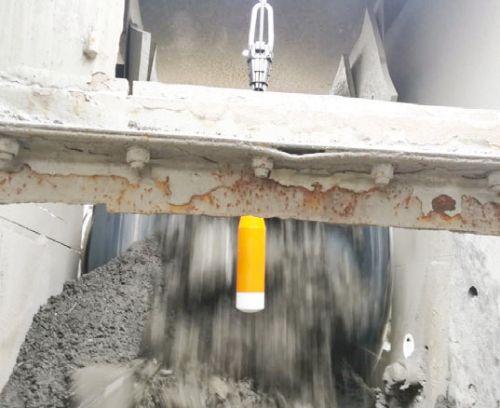
How to remotely monitor the feeder level?
The new tilt sensor (ZZ0700) has been designed for heavy industry applications and can be used to monitor the level of ore, coal or any other granular material. With its robust aluminum housing and non-stick Teflon side, the capacitive sensor, which can be remotely adjusted via IO-Link, detects the level of the material in question without false positives.