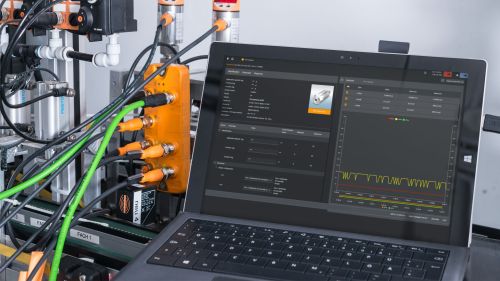
- IO-Link — main page
- Technology
Learn more about IO-Link technology in detail
The global standard: IO-Link
Before IO-Link became established, sensors and actuators primarily used binary and analogue signals. These transmit only limited diagnostic data. With the global IO-Link standard, more and more precise values are now transmitted and a wealth of diagnostic data is provided. At the same time, the complexity of sensor connections is reduced, system design is simpler, cabling is streamlined, and integration options are more diverse.
IO-Link technology can be integrated into automation systems with PLCs and also into IIoT technologies. In general, IO-Link offers three types of data, which vary from sensor to sensor: cyclic, acyclic, and event-related data.
Additional IO-Link benefits
ifm offers additional information and functions as standard in many of our IO-Link devices

In the cyclic data
- One sensor – multiple process values
- Standardised process data structures
- Device status
- Sensor technology with extended and controllable function

In the acyclic data
- Identification: Tags for application, function, and location, product URI ("Identification Link" according to IEC 61406)
- Sensor-specific data such as operating hours counter, switching cycle counter, and internal temperature

Event data
- Diagnostic data overview
- Diagnostic data storage
Use in a PLC
Cyclic data
It is very easy to use cyclic data in a PLC. An address range and size are defined. These are described in the IO-Link interface description and are available for each ifm sensor on our website. Correctly defined, the data is available for use in the programme.
At ifm, we standardise the data structures and help you integrate IO-Link devices quickly and easily into your systems. Depending on the mapping, the process data for some devices may need to be calculated or the address range adjusted (bit shift, byte swap, factor).
Acyclic data
Acyclic communication enables access to specific parameters and enables the configuration and adjustment of device parameters
- via software such as moneo blue or moneo configure
- via function blocks in the PLC
- for Profinet: Integration of parameters into GSDML is possible (PLC Tool)
Use in IIoT
Various communication methods are available for IIoT communication. The master can communicate via REST API, MQTT, or OPC UA. The information is available in JSON format. Cyclic, acyclic, and event data can be read and written. ifm offers simple solutions that convert the data into readable information using the machine-readable IODD and make it available to downstream systems.
The "IO Device Description" (IODD) contains details about the information available from the device, such as identity, parameters, process data, diagnostic data, and communication properties. The IODD is usually downloaded as a .zip file and contains an .xml file and product photos.
Some engineering software, such as our configuration software moneo configure free, and some automation systems can use an IODD file directly. In most cases, however, using the IODD is not necessary, as you only need to know the location of the available data. ifm publishes the IO-Link interface description (PDF file) in a human-readable format to help you understand the information you have access to.
- All IODDs from all manufacturers can be found in the IODDfinder
- The IODD and the IO-Link interface description in PDF format can be found on our website in the download area for each IO-Link device.

Excerpt from IO-Link interface description for SD5500 (only input data)
An IO-Link master typically provides multiple IO-Link ports for connecting IO-Link devices. A distinction is made between A and B ports. This is standardised across manufacturers and described in the IO-Link specification.
- The IO-Link community provides a list of devices that have been tested and approved for compliance with the specification.
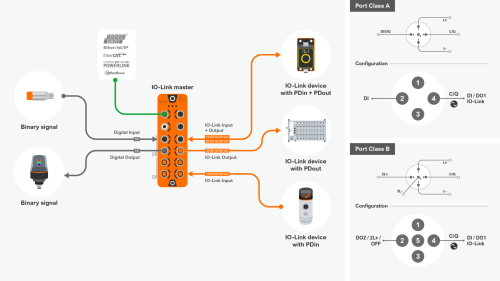
Depending on the data rate and response time requirements, IO-Link distinguishes between three communication types: COM1, COM2, and COM3.
These transmission types define the baud rate of the point-to-point connection between the IO-Link master and device and enable optimal adaptation to different applications:
- COM1 – 4.8 kbaud
For simple sensors with low data volumes. Particularly suitable for longer cables or electromagnetically polluted environments. - COM2 – 38.4 kbaud
The proven standard for many industrial applications with a balanced ratio of speed and stability. - COM3 – 230.4 kbaud
For high-performance sensors and actuators with high data volumes and short cycle times – ideal for fast measurement or control processes.
The appropriate communication type is automatically selected when the connection is established between the master and device. This ensures reliable, application-specific communication at all times.