|

Development
|
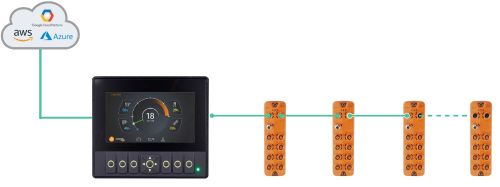
- Simple sotware management: An all-in-one (PLC + HMI) controller uses one free programming software
- Software flexibility: Support multiple programming laguages (e.g. ladder logic, structured text, sequential function chart (SFC), function block diagram (FBD), and control flow chart (CFC)).
- Additional software benefits: Includes built-in IIoT functionality and features like recipe management, trending, and data logging
- Enhance process data quality: Digital communication eliminated analogue-to-digital conversion errors and provides diagnostics
|
- Unnecessary software management: A two-piece system (PLC + HMI) requires separate software for each component.
- Software constraints: Restricted to one programming language (e.g., ladder logic)
- Proprietary software subscriptions: Expertise in proprietary software is also necessary.
- Analogue-to-digital conversion errors: Potential data losses occur when the signal converts from analogue to digital to integrate with software.
|
|
Production
|
- Streamline labour and assembly: An all-in-one (PLC + HMI) IP67 rated controller that is field mountable eliminates the need for separate control cabinets and terminal wiring.
- Improve scalability: Reduced BOMs and M12 connection technology leads to faster build times.
|
- Labour and assembly challenges: Wiring harnesses, terminating wires, and IO cards can increase labour. Integrating third-party control panels can lead to longer assembly times.
- Unnecessary hardware management: A two-piece system (PLC + HMI) requires larger cabinets and excessive terminal wiring.
|
|

Service
|
- Expedite installation and troubleshooting: M12 connection technology facilitates ease of assembly and allows for field IO connections.
- Improve operator experience: Create an intuitive experience with fully customisable high-resolution and touch screen displays. Eliminate human error with real-time feedback and alerts.
|
- Troubleshooting challenges: Wiring harnesses, terminating wires, and IO cards increase troubleshooting times.
- Complex interface: Complicated display navigation requires training.
|
|

Financial
|
- Reduce lead times: Reduced BOM and M12 technology improve efficiency to meet customer demands.
- Cost savings: No additional costs for software benefits.
- Labour savings: Eliminating terminal wiring leads to savings in material costs, labour-intenseive processes, and maintenance and troubleshooting costs.
|
- Increased lead times: Integrating third-party control panels can lead to higher costs and longer lead times.
- Reoccurring costs: Proprietary software subscriptions and support.
- Hardware costs: Increased BOM leads to higher costs in components, labour, space requirements, maintenance, and support.
|