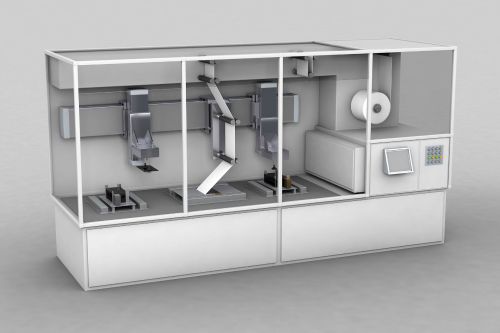
Precise Z-folding of electrode sheets
How reliable, precise position detection significantly influences product quality

Increased product
quality

Precise
position detection

Cost
savings
Results
- Reliable, precise position detection
- Increased product quality through more exact position detection
- Cost savings through simplified wiring
The challenge
Z-folding is a technique in battery production in which individual electrode sheets are placed on a separator film, which is then folded several times, creating a kind of zigzag pattern. The advantage of this method is that it minimises the voltage in the battery cells and prevents contact between the anode and cathode, thereby reducing the risk of fires and short circuits. During notching, the electrode sheets are cut out into specific shapes and sizes so that they can then be applied to the separator film during stacking. These processes are crucial for producing battery cells with high precision and quality. The precise positioning of the electrode blades and the avoidance of damage are key quality criteria. Therefore, precision when cutting and positioning the electrode sheets must be ensured at all times. Even the slightest deviation can adversely affect the power and safety of the battery cells, significantly reduce the service life of the battery and even cause short circuits. These challenges require precise control and monitoring of production processes, such as the positioning of electrode sheets using pneumatic gripping systems, in order to ensure the quality and safety of the battery cells. To ensure that these remain functional at all times, a system with a diagnostic solution was required.


The solution – why ifm?
To precisely detect the positions of the electrode sheets and separator films, the customer uses O5K500 optical contrast sensors and several inductive sensors. To ensure that the components can be reliably detected and positioned by pneumatic grippers, pressure sensors for pneumatic systems (PQC812) monitor the pneumatic pressure. These are required to pick up the electrode sheets. The monitoring immediately detects errors. The sensor data is transmitted via IO-Link masters from the DataLine series. The Y-path is used, via which the data reaches both the controller and the IT level. Through the digitalisation of the sensor data, commissioning and maintenance could be optimised, better OEE achieved and costs reduced by about 70%.