Improve quality of calibration process
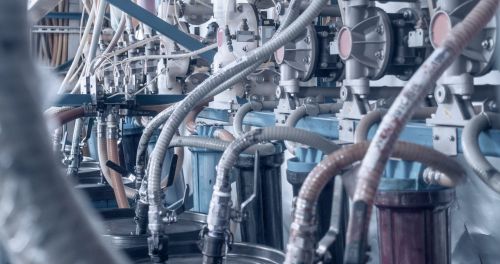
Efficient refilling process
Goal of the project
The calibration of flow sensors takes place in the calibration plant at ifm prover gmbh.
To ensure maximum measuring accuracy, both hot and cold water is sent through the sensors. The measured values are used for calibration.
Enough water must be present in both tanks to ensure optimal calibration procedures.
In order to avoid unplanned downtimes in the future, permanent, software-supported level monitoring was to be implemented. This was supposed to inform staff in good time of low water levels or maintenance requirements by means of warning and alarm signals.
The initial situation: Visual inspection of the water level
In the past, ifm prover gmbh would determine the level of the water tanks daily by means of visual inspection by the employees. There was no visualization of the current water quantity or any limit value monitoring with alarm function. As a result, the calibration process repeatedly came to a standstill in case of insufficient water quantities, which would lead to downtimes and, thus, increased costs. Due to the lack of data recording, there was no transparency regarding the refilling processes. Neither was it possible to determine the maintenance requirements and plan them in good time.
The implementation: Level monitoring with moneo RTM
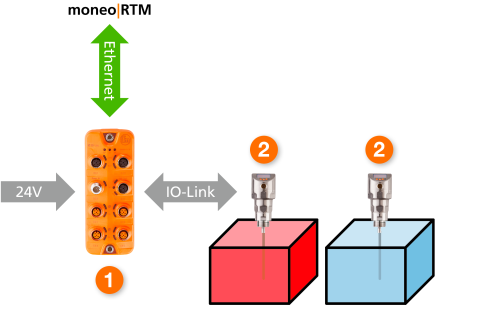
Thanks to the existing IT structure, moneo Cloud was deployed to activate the moneo RTM module. The level sensors for tank monitoring are connected to an IO‑Link master, which transmits the process values to the cloud.
The result: Uninterrupted calibration process
Level monitoring with moneo RTM has led to a more reliable and uninterrupted calibration process. Thanks to the automated notification function when the limit value is not reached, the water demand can be automatically met, thus reducing the cost factor of calibration. Another result of automated level monitoring is the stable assurance of high product quality based on consistently ideal process conditions.
Bottom line: Value added services in level monitoring
- Calculated values: Sensor values can be converted to process-relevant information with the help of data modelling
- Cockpit functions: comprehensive and individual visualization of all sensors in the process
- Detailed information about levels by capturing sensor values
- Integrated alarm management: Fast reaction to changing process parameters
- Analysis: increase of levels according to the requirements by means of targeted evaluation of historical data
- Identification of limit values that are exceeded or not reached
System structure
- IO-Link master
- Continuous level sensor (guided wave radar)
Dashboard
The moneo dashboard provides a clear overview
The dashboard provides the user with an overview of the relevant process values for the calibration plant.
- Current tank level in mm
- Current tank level in liters
- Lacking water quantity in liters
- Traffic light display for the warning and alarm values of the level
Analysis
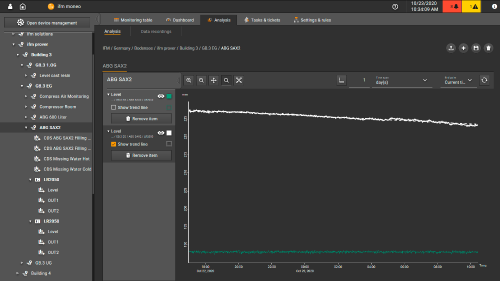
Via the analysis function, the user can analyze the tank level in detail. The level values are permanently recorded and can even be checked after days, weeks or months. This allows, for example, to draw conclusions about leaks.
Tasks & tickets: managing limit values
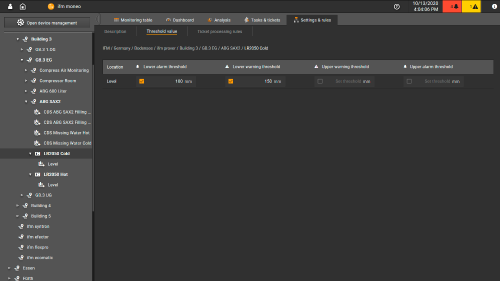
For the two level sensors, values for the lower and upper alarm limits are defined on the basis of maintenance experience.
Calculated values
The following values are calculated additionally based on the level.
Current tank level in liters
Since the floor space of the tank is known to be 0.24 m², the fill quantity can be easily determined by using the formula "floor space * level."
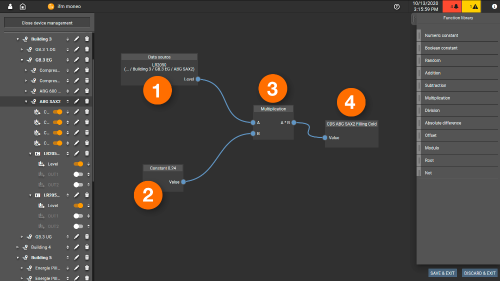
- Current tank level in mm
- Floor space of the tank
- Multiplication of floor space and level
- Volume in liters as result of the calculation
Lacking water quantity in litres
Since the maximum volume of the tank is known to be 72 litres and the current fill quantity has already been calculated, the missing quantity can easily be determined via "maximum volume - fill quantity."