CLEAF – Compressed air optimisation in furniture panel production
|
|
Summary Data rather than assumptions: The Italian company CLEAF develops and manufactures high-quality coated panels, laminates and edging for furniture and interior design. To provide transparency regarding the high energy requirements of its production, CLEAF relies on smart sensor technology and the moneo IIoT platform from ifm. The result: greater transparency, well-informed decisions, lower energy costs and condition-based maintenance. |

Transparency that pays off
CLEAF uses sensor technology and the IIoT platform moneo to make compressed air consumption transparent, reduce energy costs and optimise maintenance.
For over fifty years, CLEAF has been synonymous with innovative surface solutions for the world of interior design. The Italian family-owned company develops and manufactures faced panels, laminates and edges for furniture and interior design. In today’s energy-intensive manufacturing environment, however, product quality alone is no longer enough. Combining competitiveness, sustainability and efficiency requires comprehensive insight into processes based on accurate, real-time data. This need led to a collaboration with ifm: CLEAF partnered with the automation specialist to develop a solution that provides visibility into energy flows and continuously monitors the condition of its most critical equipment.
The key step: from overall consumption to machine-level data
In many industrial plants, compressed air is one of the most expensive yet least transparent energy sources. At CLEAF, too, compressed air consumption was for a long time only available as an overall figure: there was no visibility into which machines consumed the most energy, where unnecessary loads occurred or where leaks were affecting consumption. Critical information that remained largely hidden in day-to-day operations. Cristian Fortunato, Head of Maintenance at CLEAF, describes the initial situation as follows: “Before this monitoring solution was introduced, specific consumption was virtually impossible to see.” And that was precisely the limitation: With only aggregated data available, it is difficult to detect deviations, understand their causes and identify areas for optimisation. Only direct measurement at the relevant points of consumption provides clear insight into what is actually happening within the process.
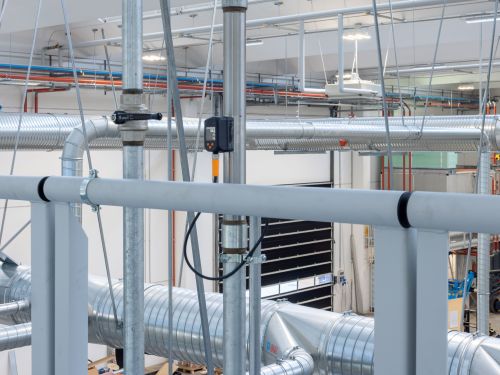

Image 2: A flow sensor is installed in each compressed air line. This allows consumption to be accurately.
Image 3: A vibration sensor is installed on the fan motor.


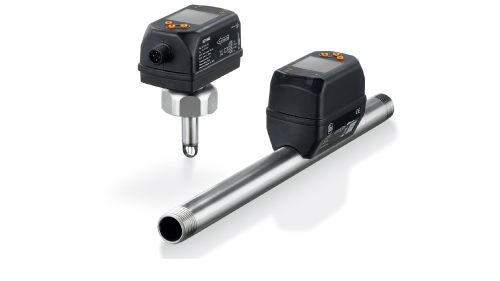
Image 1: Compressed air sensor which records not only the current flow rate but also other measurement values.
Compressed air sensors: more than just meters
To achieve this level of transparency, CLEAF relies on ifm flow sensors from the SD9500 and SD8500 series as well as SD2500 series sensors for larger pipe diameters. Bruno Bonfiglio, Maintenance Support Specialist at CLEAF, describes them as “the basis for monitoring compressed air consumption across the plant”.
A key technical advantage: The SD sensors go beyond flow measurement, combining several process-relevant parameters in a single device. In addition to compressed air flow, they provide data on total consumption, pressure and medium temperature, creating a solid basis for both energy and process-related assessments.
This level of detail proves particularly valuable in compressed air applications. Inefficiencies are not only reflected in overall consumption figures, but often become apparent through recurring patterns: unusual consumption levels during certain shifts, high base loads, deviations in the behaviour of individual machines or fluctuations in the distribution network. Continuous monitoring of this data helps detect leaks, inefficient usage and emerging anomalies at an early stage. It was on this basis that CLEAF was able to move from empirical estimates to decisions based on objective, measurable data.
Consumption data informs decision-making
In operational terms, this represents a significant shift in perspective for CLEAF. Consumption data are no longer merely indicators for reporting purposes, but are becoming concrete tools for operational decision-making. Comparing machines, production areas and shifts immediately highlights any anomalies. At the same time, the company can determine whether maintenance measures, the replacement of components or process adjustments actually lead to improvements.
Cristian Fortunato sums up this shift succinctly: “We know where we need to intervene and can make data-driven decisions instead of relying on estimates.” This turns average consumption, which was previously difficult to attribute and therefore hard to manage, into a controllable variable. At the same time, reactive troubleshooting is replaced by a systematic optimisation process.
moneo: from data to the bigger picture
For the data collected by the sensors to deliver genuine added value, simply collecting it is not enough: it needs to be processed and presented in a way that is easy to interpret. At CLEAF, this task is handled by ifm’s IIoT platform moneo, which collects the data, stores it in a structured manner and makes it available for analysis and evaluation via intuitive dashboards. In addition, the system enables continuous real-time monitoring and automatically issues alerts if thresholds are exceeded or not reached.
moneo was developed to support machine monitoring, process optimisation and more predictable maintenance, and is a key tool for CLEAF in its day-to-day operations management. The dashboards provide a clear overview of current and cumulative consumption, trends over time and potential anomalies, turning a multitude of measuring points into a coherent picture of equipment behaviour. For good reason, Bruno Bonfiglio emphasises the importance of a “simple, stable and reproducible” solution that can be easily scaled across multiple plants and applications.
Vibration sensors: when data drives maintenance
In addition to energy monitoring, CLEAF also uses vibration sensors from ifm to monitor the condition of drives and critical equipment. On fans and motors in particular, vibration analysis enables early detection of signs of wear and potential failures.
Many mechanical faults do not cause sudden failures, but instead reveal themselves through gradual changes in vibration patterns, which may be caused by unbalance, bearing wear or increased friction. In this context, the sensors do more than simply trigger an alarm in the event of a fault: they enable condition-based maintenance of the machines.
Maintenance is no longer based on assumptions or fixed intervals, but on objective data that enables targeted, timely action, reduces the risk of unplanned downtime and improves overall plant reliability.
Advanced monitoring of rotating machinery
From a technical perspective, modern vibration sensors offer far more than simple threshold monitoring. ifm’s solutions make it possible to determine specific parameters for assessing machine condition, relating, for example, to mechanical stress, impacts, friction and early signs of bearing wear. This makes it possible not only to detect a deviation, but also to understand the nature of the phenomenon occurring.
For companies such as CLEAF, this means having a more comprehensive overview of the condition of fans, motors and other critical components whose condition is often difficult to assess but which are essential to production continuity. A sudden failure of these components can jeopardise the entire process chain. If, on the other hand, an anomaly is detected in time, corrective action can be scheduled during maintenance windows, significantly reducing the risk of disruption.
Cristian Fortunato sums up the benefits as follows: “This means less downtime, improved predictability and much more targeted maintenance.” This is the key step towards a more advanced approach: maintenance is no longer triggered by a failure, but by the actual condition of the machine.


Image 4: The evaluation units analyse the vibration signals from the sensors and trigger an alarm if thresholds are exceeded.
Image 5: The vibration signals are displayed graphically.
Anomalies become apparent.
Scalable across multiple plants and applications
Another strength of the ifm solution is its scalability. CLEAF was not looking for a solution limited to a single application, but rather an approach that could be extended to other plants and facilities over time. As Bruno Bonfiglio points out: “For us, it was crucial to have a solution that can be easily scaled to other machines.” In this context, standardised sensors and centralised data management via moneo are key prerequisites.
The project therefore goes beyond simple consumption monitoring, evolving into an infrastructure that supports continuous improvement. Energy data can be systematically compared, and maintenance strategies can be refined over time based on objective data insights. New machines can be integrated into an existing, structured monitoring system from the outset.
A strategic lever for the entire organisation
For CLEAF, the project delivers value beyond day-to-day operations, extending directly to the strategic level. Owner and
Managing Director Roberto Caspani points to the company’s high energy demand and the expansion of renewable energy sources: “To improve and grow, we need to know exactly how much energy we use and where and how we can take action.”
In this context, ifm’s contribution went beyond supplying the technology to include expert support throughout every stage of implementation, backed by application expertise and technical know-how. As Cristian Fortunato emphasises: “At the end of the day, we have found a partner in ifm, not just a supplier.” A crucial aspect of data-driven projects: Only when the sensors, platform and application work together seamlessly can they deliver real value to the company.
Conclusion
CLEAF’s experience shows how energy efficiency and condition-based maintenance can be combined in a single approach. By monitoring compressed air, consumption that was previously difficult to quantify at machine level can now be accurately measured and compared, providing a basis for targeted, verifiable action. Vibration sensors complete the picture by providing a clear overview of the condition of critical equipment and enabling timely intervention.
Combined with the moneo platform, tthe result is not an isolated project, but a structured and scalable data foundation that supports more informed decisions, improves overall efficiency and enhances the reliability of production processes.